Showing posts with label Bauchi. Show all posts

Wednesday, May 23, 2012

Trip Summary

I was asked to write a Reader's Digest version of my last 2 1/2 months in Nigeria for a newsletter. I figured I would write a summary blog on my last day here. I am mostly packed and ready to head to the airport in about 5 hours. In all this was a successful trip. There were some frustrations. I had delayed my trip a few weeks so I would arrive after the Health Board had there two weeks of administrative training. Their training got delayed two weeks. At the end of the trip there was problems with transferring money to a driller and that delayed the drilling of the Waya borehole to the very end of the trip.

I should introduce myself for those who do not know me. I am Jay Johnson. I am a professional engineer. I am a retired Lt. Colonel from the US Army and Army Reserve. I have traveled extensively in my military and professional careers. Since 2006 I have been traveling to Nigeria annually. The first two trips were short two week visits with the Minneapolis Areas Synod / Global Health Ministries Public Health Evaluation Team. Starting in 2008 I visited by myself for visits of 6 week to 10 weeks. In 2008 my purpose was to start learning the people and culture. I visited all the Dioceses of the Lutheran Church of Christ in Nigeria and over 100 villages. This is when I composed my three priorities for village water. 1. A village wants to have enough water to survive. 2. They want the water as close to their village as possible. 3. They want safe water.

The Lutheran Church of Christ in Nigeria is based out of Adamawa State. Adamawa is a rural state in the northeast part of Nigeria on the border with Cameroon. It is mostly savannah. Deforestation is almost complete except in a few preserves and hillsides too steep to farm. They have two seasons. Dry season is from October to June. Rainy season is from June to October. In the southern part of the state the rainy season is longer and in the northern area it is even shorter. In the capital Yola the annual rainfall is about the same as Minneapolis. Except it is concentrated in a short period of time. Farming is mainly a rainy season business. We have had several rainfalls and the countryside is turning green. The vacant farm fields are now busy with people with hoes, or cattle pulling plows and tractors plowing. The sorghum has sprouted in some areas and the maize is being planted. On weekends the people from the cities head to their villages and plant their crops.

My original purpose in coming to Nigeria was to start my retirement career as a non-denominational water, sanitation and development consultant. All of my trips have been centered on clean water and sanitation, but have included work in community development. The three main organizations I work with are the LCCN Health Board Water and Sanitation/Hygiene (WASH) Team, the LCCN Deaf Centre and Spring of Hope HIV/AIDS Support Group. Over 90 percent of my efforts are with clean water.

This trip had a slow start as my main contact Yakubu Bulama the Water Coordinator for the Health Board and Projects Coordinator for the LCCN was working with the Health Board Administrative training for the first two full weeks I was in the country. I spent these weeks setting household in the old mission house on the LCCN Compound and visiting with the Deaf Centre. The guards at the Cathedral Church in the adjoining compound called my house the "falling down house."

 My travels this 10 weeks has probably totaled around 4,000 kilometers (2,500 miles) by road in public transportation and in LCCN owned vehicles. This was the most dangerous part of my time. Many of the drivers are not licensed. Some went from riding bikes to driving cars. Others drove motorbikes and drive their cars the same way. Few know the rules of the road. When I got my license I paid an extra 1,500 Naira ($10) so I did not have to talk to the driving examiner. The manager just gave me my license and told me that was what the extra money was for. 

Water accomplishments: There are more accomplishments than disappointments. Some of the disappointments are actually accomplishments (or steps towards accomplishments.)  The main two accomplishments were fixing the water distribution system at Banjiram and drilling two productive boreholes at Waya and a third at Polchi. (Waya and Polchi are in Bauchi State and are mission villages of the LCCN churches in Jos, Plateau State). We also were able to go to Timbukum, in the southern part of Adamawa State to start the review of the non-functional solar powered borehole that the Nigerian Government with money from the US Government had installed and never worked. We found that the pump was installed at the very top of the water table. The next phase which will do done after I leave will be to determine if the borehole is deep enough to lower the pump to under the water. We be a preliminary survey of the broken water system at the Government Secondary School in Hong that the PTA had asked for our assistance. In Pella we got to review the large hand dug well near the LCCN Maternity Clinic to determine the possibility and estimated cost to clean out the bottom of the well, cover the well and add a hand or powered pump. This is a highly productive well that has had continuous water for several decades. The water was over 6 feet deep. The hardest part of this project will be to find pumps capable of de-watering the well so the well diggers can enter and remove the several decades of debris that has accumulated.

Disappointments: We performed a geophysical survey of two points in the community around the Sabon Gari B District Church on the edge of Mayo Belwa. The survey indicated that there was not a significant amount of groundwater for a productive borehole at the two locations surveyed. However, there are several productive motorized boreholes operating in the area. The next thing for the community to do is to go to the owners of the productive boreholes and find out how deep they are and if possible measure the static and dynamic water levels. Likewise, the geophysical survey of the area where they want to install a borehole at Gada Biyu in Bauchi State found very little indication of groundwater. We have asked the geologist if an improved hand dug well might be possible. This village may require some more innovative system for obtaining water during the dry season.

Other Work: LCCN Deaf Centre is moving towards being able to serve more of the Deaf Community of Adamawa. Last week the Yola Bishop requested that the paperwork for the Ordination of Ruth Ulea as the first deaf pastor in the LCCN be forwarded to the Jimeta District Church. By tradition a candidate's home district is suppose to call pastors.Ruth's home church is in Arewa Diocese in Hong. They have sat on her application because she does not serve their community and for some other reasons. The LCCN Constitution on specifies that a District Church will call a pastor. In Ruth's case she provides Sunday School and church services in Jimeta and several other locations in the Yola Diocese. We fixed most of the roof leaks in the patio area where Ruth holds Sunday Services and I bought 7 sets of jewelry and some bracelets that some of the women make to support the Centre. They normally sell them for 300 naira in the local market. I talked them into sell them to me for 500 naira. I will be putting them up for bid on a website for a minimum of $10 (1,570 naira) with the profits going back to the Centre. I have started work on some concept designs for improvements to the LCCN Deaf Centre and improvements to the location that Church services are held at until a new church can be located, designed, financed and built. I was able to attend a meeting of the Spring of Hope HIV/AIDS Support Group. A part of the group has been trained in soap making. They only need $400 to buy the molds and ingredients for their first batch of soap. They have test marketed some of the soaps in their home villages and found that market to be more viable than in the more competitive Yola market. I hope to raise the $400 as a micro-loan when I get back to the US. I have made progress on fixing my "falling down house". The main opening that rats and mosquitoes come in through has been screened. There are two major roof problems that are washing away some of the mud bricks in the kitchen wing that will need attention soon or the kitchen wing will fall down. For the first time in the last three trips I have been able to stop and shop at Women of Hope store in Jos. I will be leaving the country broke but I purchased 71,000 naira of their merchandise. It will be for sale at the Mount Calvary Annual Fair Trade Fair the first weekend of November. I have a great tan from the elbows down and since I have driving the last month the left arm is now balanced with my right arm.


I almost forgot. After three years of sitting in Gaye Guyton's living room. The boxes of books that were collected for the Remi Foundation, the books I collected for the Bronnum Lutheran Seminary and the LCCN Deaf Centre arrived in Jos and I picked them up Saturday when we were there for the Waya borehole drilling. They were all distributed on Monday. The Deaf Centre library went from about a dozen books to almost 100. They are considering allowing the students to take some of the books home to read overnight. I have been in locked libraries at schools. Most schools to not have a library at all. The Jimeta Cathedral school has a room in their new expansion designated for a library but does not have books. The culture of reading is very small. Most students only read text books and some have workbooks.


Sunday, April 8, 2012

Waya - Long Trip - Several Challenges

 I written and re-written this blog a few times. It is always too long. I get too much into the technical details that would interest the people on the Minneapolis Area Synod, Water Committee but not what regular people would be interested in. Yes guys you are not regular people.

We started the trip to visit Waya from Jimeta in Adamawa state on Monday morning April 2. We traveled through Numan and up to Gombe where we stopped for lunch at a roadside cafe near the bypass junction. Clean place and the three of us ate for 850 Naira ($5.40). It was a quick lunch. Then back on the road for Jos. We had arranged for a 6:30 dinner meeting for the pastors, mission committee members and the driller from Jos. I was called on our way to Bauchi and asked to hold the meeting at 5:00 PM so people can get home before it got dark. The security situation in Jos makes travel at night difficult. I checked with Yakubu and my GPS, both said we will make it in time. We moved the meeting to 5:00.

As we were going through the railroad crossing on the east edge of Bauchi, a group of young men in safety vests, tossed boards with nails in them into the road and signaled us to pull over. We did. They told us they worked for the local government and were inspection vehicle certifications. This is a national program which authorizes the local government to certify vehicles and issue decals for the Local Government, State Government, Federal Government and other groups. Adamawa State was not yet doing this. We told them we were from Adamawa and would get the certificates when we returned. They said we could not pass until we paid 25,000 naira ($160). Yakubu told them we do not have that kind of money and explained to them that we were NGO's and were working on drilling boreholes in Bauchi State so their people could  have water. That they had educated us and we should now go. The young men were firm they wanted their Naira. We asked for their identification. They refused. We said OK one of you get in we will go to your office. They said no not until 4:00PM. We got out and hailed a taxi to go to the Bauchi Local Government offices. There we discovered the boys were working for a contractor for the local government tax collector. After an hour of arguing the head of the tax department called the contractor and asked him to come over. We ended up paying only 15,000 Naira and got the stack of certificates. Now it will be hard to get to Jos by 6:30.

We had our meeting with the District Pastor and the the District Church Mission team. Waya was not a concern to them. Then wanted to know when we were to start drilling in Polchi and Gadabiyu. I have not visited Polchi but did visited Gadabiyu last year. They said that the money for boreholes had been donated and they wanted the boreholes drilled. Yakubu explained the procedures to do the work. That the Water Team was part of the Medical Board now and the objective is to improve the health of the village. The village has to be prepared and have to agree on providing part of the funding, agree to maintenance, agree to sanitation and hygiene training and agree to building of VIP latrines if they do not have latrines in the village. They said the Danes did not have these requirements. The Danes do not require the village to give any naira just collect sand and give labor. We explained that our experience over the past five years is that naira was precious and labor or sand were of little value. If the village wanted to be part owners of the project they would donate a little naira. If they donate naira they will feel like they own it and will maintain it. I told them that we are not the White Man coming to help the Poor Nigerian. The Nigerian can help himself and we would help but we will not pay everything. The mission chairman seemed to understand but I do not think I made a friend of the District Pastor. It was now near 8 pm and the generator had little fuel. We arranged to meet the Catechist from Gadabiyu as our guide to Waya the next morning. We checked into our rooms to discover the water tank was empty that supplied the rooms and the barrels in the rooms were also empty. So we fetched water from the hand pump down by the main house and shared the little drinking water that was in our rooms. The next morning they turned on the generator and pumped water to the tank after we were at breakfast. 

 The next morning we were to meet the geologist at 8 to leave for Waya. They were there at 7. I am impressed with them. So far everything they have done has been professional and timely. Of course they wanted to leave and we wanted to eat breakfast. We did not know when our next meal will be. While we were eating they went to get camera batteries. We finished breakfast and needed to buy a little oil for the truck. The water truck is a 1995 Toyota Hi-Lux with a rebuilt 2.8 liter diesel engine. The only size of diesel engine oil the Total Station had was 4 liters. As we added the oil, the geologist called and we told them where we were. We joined up and then got another call. The Grace and Light Mission people had arrived back at Dogan Dutse Guest House with HIV test kits for their Yola office. We told them where we were and waited for them. The test kits were quite useful at the check points. When the soldier or police man asked what was in the bag and we said HIV test kit. He would look at me and I assume he assumed I was a doctor and would wave us through. Much easier than when our clothes or computer bags were on top of the piles.


Waya is a small village that was visited by a pastor from North Dakota a number of years ago. He was disturbed at the water the people were drinking. He decided he cannot help everyone in the world but he can help this one village. He has now contributed enough money to install two boreholes, two VIP latrines and provide sanitation/hygiene training in the village. VIP latrines are Ventilated Improved Pit latrines (not Very Important People latrines). The LCCN water program is part of the overall medical efforts of the LCCN to reduce illness and preventable deaths. Clean water at the water source by itself has a little effect on health. Clean water that is kept clean by proper sanitation and hygiene efforts have a greater effect. Hand washing, proper food handling and using a VIP latrine (followed by hand washing) will have the greatest effect on the health of the village. Sanitation and hygiene are harder to sell to the villages and the churches supporting the villages. Borehole water is seen as a status symbol and the cause and effect are immediate. When you are thirsty you drink water and quench your thirst. But for sanitation and hygiene the link between disease and sanitation is more remote and less easy to understand. When you get sick today it is harder to understand that it was caused by something you eat or drank up to 3 days ago. As long as I am up on my “Soap Box”, here is Jay’s understanding of the water priority for people living in rural villages: 1. Be able to collect enough water to live. 2. Have a water source as close to where you live and farm so you do not spend all day just collecting water. 3. Have clean water.

Hand dug well that is nearly empty. The water is muddy. Other hand dug wells had more water and were clear.
The village is split by a stream that floods during the rainy season. A single borehole would only help one side of the village. I changed my travel routine last year and visited the village on my way into Nigeria. Instead of flying from Abuja to Yola, I went by land and stayed a few day in Jos. The Jos District Church is the church that has worked with Waya in the past. The two churches in Waya are part of the Jos Distirct. Due to some confusion last year about two Pastor Emmanuels in Jos I was only able to visit Waya for a short time on a Sunday afternoon. I did not get in contact with the correct Pastor Emmanuel until Friday evening. During my brief visit I performed an initial survey and later created a draft project description and initial budget. It was 10% higher than the pastor had intended to donate. He said no problem, he can find another $1000.

Yakubu and Gary Sande from Global Health Ministries visited Waya last fall after the donor’s conference in Jos. They visited three villages. Waya and the two current mission out-reach areas of the Jos District (Gadabiyu anbd Polchi). Like my trip, their visit was brief in each village and they were not able to talk with the chief about the requirements of village participation, maintenance, sanitation and hygiene. I only visited 2 villages the third was too far for an afternoon visit. They started earlier and went to all three with the furthest village last and took back roads to Bauchi from there. They arrived late into the evening and totally worn out by the long day of driving on bad dirt roads.
 
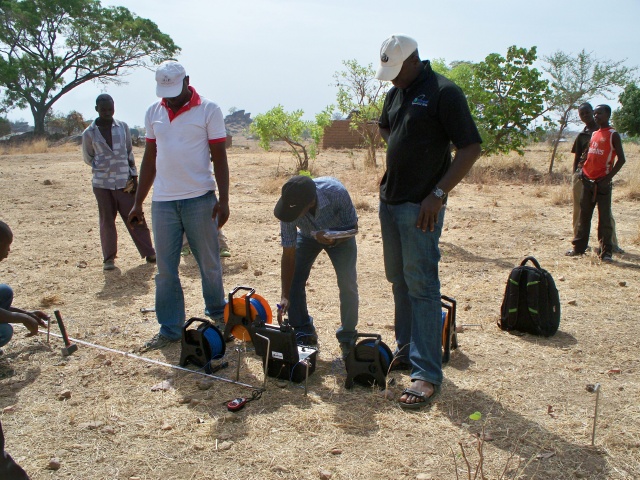
We arrived at the less populated side village where the older Church is located with the driller, three geologists and their helper. We explained to the geologist that we did not want the borehole sited at the church because the Muslim part of the village would not use it. The geologist looked over the area and decided on three potential sites. While they were starting the geo-physical survey Yakubu went to the other side to speak with the chief. The chief had heard of the project and the village would be glad to participate. Wherever the geologist decide to put the borehole he will talk with the owner of the land and make sure they understand that it is a community borehole and he as chief fully supports the project.
 
We spent the whole day at Waya while the geologist performed surveys at six site. I spent most of the time in shade. In spite of SPF 30 sun screen my arms and neck got a little burned. This sun here is SPF 60. I had brought along a red and white checkered cloth. I soaked it in water and put it over my head to cool me and to protect my neck. I was told I looked like Yassar Arafat. As I walked up to the drillers they joked they thought that Al-Qaeda was coming. The kids would come to see the Batura but would not get close to me. For many of them I was the first white man they had seen. Others had seen me last year and Gary last fall. But they still would not get close to me until it was time for a picture.

The bad news is that the hydro-geology of the area does not look good. The basement rock is pretty solid and appears that the water is in the overburden and it the top few meters of the basement where the rock was weathered many centuries ago before it was buried. The plan is to drill through the weathered rock down into the solid material to make a reservoir to pump from. We will get the cost estimate for the work next week. We had hoped to find a site capable of handling a future solar powered borehole. But the rock fractures do not go deep. Even the hand pump may run dry. This is a site that my benefit from small check dams in the streams to force more water into the earth. The pro is a higher water table and less erosion. The con is that some loss of farm land could happen.
Little girl posed for me. I took several picture before a got a good exposure and good smile.

We ended the day at Bauchi with a visit to the Bauchi Church to talk to them about their project with Redeemer Lutheran of Minneapolis. Their companion congregation has raised enough money to install one borehole. The Bauchi Church has a mission field of six villages. All have similar problems with water. They want to put in six hand dug wells instead of one borehole. Gamakesa from the LCCN Rural Development Department had spent the previous day visiting all the sites. He will give us a cost estimate for the six hand dug wells with concrete walls, concrete covers and hand pumps after Easter. In general a properly built hand dug well is about half the cost of the borehole. The money that is available for their project will not cover 6 hand dug wells. They seemed to think that this was not a problem that Redeemer will furnish the funds. Yakubu went through the same conversation about participation that we had the previous evening in Jos. Then I told them that I was familiar with Redeemer Lutheran. That they are a small church in the poor part of Minneapolis. That they had worked hard for several years to save enough money for one borehole. I explained that Redeemer are involved with many programs in their own community. They feed the poor. They provide housing. They have youth programs and many other programs to help the poor in their community. Many of their members are poor themselves. They are a very active church that stretches their financial resources to the limits to help their neighbor in Nigeria and in America. It was hard for them to raise the money they have raised so far and do not expect that they will be able to quickly raise more money. (Sorry, my friends at Redeemer if I misrepresented you.) They were impressed that their companion was such an active church helping the poor. It probably is not my place to give the people a reality check. I have to be honest. People are always asking me to drill them a borehole. I look them in the eye and say "No". After their shocked expression goes away I tell them that "I will help you build your own borehole. Nigerians are capable of making their own boreholes. They do not need me or any other American to do it for them. We can help them by they must do it themselves."

Wednesday morning we left Bauchi headed home. Stopped at the Bauchi Church to say good bye to the Dean. His wife had hot water for tea and coffee ready for us and fried Irish potatoes. The night before he had said something about Irish and I heard coffee. I missed him saying potatoes. I asked if he was going to give us Irish Coffee? He knew what Irish Coffee was and laughed and said Irish potatoes. Yakubu did not know about Irish Coffee and did not know what was so funny. Adams, the Dean and I were laughing and poor Yakubu was wondering what the joke was. I explained it is coffee with alcohol. He asked they add a little alcohol to their coffee. We laughed again and said no, not a little. The Irish add a lot. (Sorry, my Irish friends but I have stereotyped you.)

As we were getting in the truck to head to Yola, Yakubu looked at his truck registration and insurance card. They had expired. We got past Gombe and we were stopped by the Gombe Vehicle Inspection Officers. Yakubu said "this will cost me." It cost us an hour and 7,000 naira. They had a manual typewriter with them and they typed up new registrations and new insurance papers on the spot. With as many people they had pulled over the wait was to get your turn with the typist. All very professional and official. Not like the young men in Bauchi. Like Bauchi any one with local plates were not inspected. We had plates from Plateau State.

Our final stop was in Lamurde. It was partially a waste of time. The Bible College was on holiday and the principal was not available. Global Health is interested in doing a borehole for the Bible College.The road from the main highway to Lamurde can hardly be called a road. Disconnected patches of asphalt. You spend more time on the dirt shoulder than on the road bed. Probably average 20 to 30 kilometers per hour. Finally, we stopped in Numan for an Nigerian lunch / dinner (pounded rice with okra soup and a little tuff meat. Got back to Jimeta before nightfall which is 6:30 this near the equator.

Monday, March 19, 2012

March 17th - Jos to Yola - What is in that box?


Today there is only one goal. To get from Jos to Yola. Pastor Ansom picked up at 6:30 sharp. He checked my out of the lodge and took me to the bus park where I got in a bus (15 seat van) of the Adamawa Sunshine Transportation Company. The first clue there could be problems was when they push started the bus. It kept running but the shifting was difficult for the driver. Unfortunately, with the pot holes and many check points the transmission has to be shifted often as we slow or stop and accelerate back through the gears. At each checkpoint I peer out from behind the large box I am taking along with me. The policeman or soldier looks a little surprised to is a white man on public transportation. Then they ask what is in the box. I explain it is donated items from America and show them the TSA seals on the box. Sometime the driver says clothes. One soldier wanted to see documents. I should him a letter I had prepared that explained what was in the box and where they were going. He noticed my slogan “The CIA that is helping people.” and asked if I worked for them pointing to the CIA and smiling. I smiled and said yes. He laughed and waved us through. 

When we got to the middle of Bauchi at the military check point just in front of the Peoples Democratic Party zonal headquarters the gear box gave a bang and the gear shifter was no longer doing anything. The engine shut down and the conductor jumped out to get some men the help push start the bus. The driver tried to jam it into gear but nothing was happening. They pushed us to the curb. Now here we sit in front of the main political party zonal headquarters, just beyond their entrance road. People were gathering for a big meeting with to head of the party scheduled to arrive. My big box in the window of the bus. Security was not happy. The driver called a mechanic. I could hear him sawing and hammering under the bus. The puddle of transmission grease in the street told me this van was not going to move.  Finally, they told us to push it back beyond the entrance to the PDP building. People were arriving by the car load and the line to get through security was out to our bus.  Here we set with a bus full of bags and my large box. After about an hour and a half they called for another bus. Soon a truck load of soldiers showed up. The Captain shouts “What is this bus doing here. Where is the driver. Move it. Move it Now.” The people had been unloading the van and their luggage was on the sidewalk. They explained what happened and showed the Captain the transmission fluid on the pavement. He told us to push it back into the parking area for a nearby store. Soon the newer but slightly smaller van showed up. With only a 2 hour delay we were off and I was glad we were away from the biggest target in northern Nigeria. 
Loading baggage into new bus

This new van was not as long or wide as the last van. My feet barely fit between our row of seats and the front seats. The seats had more padding which was good since we had most of the journey left to go. After a few hours without being able to move my knees my old soccer referee injury began to ache in my right knee. An hour later we arrived at the Numan bridge over the Benue River and another check point. The two year old that was two rows back could not hold his pee any longer. They handed him forward and I lady held him up to the window as we crept slowly up to the check point. Some of the vendors sitting along the road quickly covered their wares.

At the check point, an Army Corporal with fancy sunglasses and an attempt at a New York accent asked me where I was from then asked for my passport. He looked at it and one of my older Nigerian Visas then asked about the big box. I told him there were computer donated in the US going to Yola. He said “Let me see them”. I told him that I have documents and he said “I don’t want to see documents, I want to see the computers.” So we emptied bus and got the box out. It had been opened and inspected at the Minneapolis airport so it was sealed with TSA tape. We found an old saw blade on the ground and cut open the boxes. There were four computers also with TSA tape and each marked as inspected. I told him. “See, 4 computer each sealed by the US Government.” He was satisfied and my knee was no longer hurting. I thanked him and told him I really needed to get out and stretch my legs. He gave me a big smile. We loaded back into the bus and headed into Yola. I turned and apologized to the people in the van. The laughed and said no problem. 

I had been texting Yakubu my progress whenever I had a cell signal. As we approached Yola I sent him a message but the status stayed at sending. Finally, I checked my account balance. My prepaid account had 0.30 Naira. I takes 5 Naira for a text. Now I can only receive calls and texts but I cannot send. Yakubu called me and I told him where were and I did not know where bus was going to finally stop. When he called again, I told him we were now turning on to the road to the market, he said he was not far behind. The bus stopped at the Jimeta “Ultra Modern” market right at 5 PM as the market was closing. The streets were jammed with motorbikes, peddlers with wheelbarrows filled with merchandise, people and cars. A few minutes later Yakubu drove in the cluster of vehicles. We tossed my box and bagging in the back of his truck and headed down the street to the Jimeta Cathedral compound. 

The kids of the security man that lives in the round house between Yakubu’s office and the old mission house I live in, saw me coming and started jumping up and down. Their family has been working on cleaning the house the last few days. No one had been there in almost a year. They had it pretty clean for having had two Harmattans this year. But there was no water in the water barrels. I will stay at the Adip Hotel for the night.