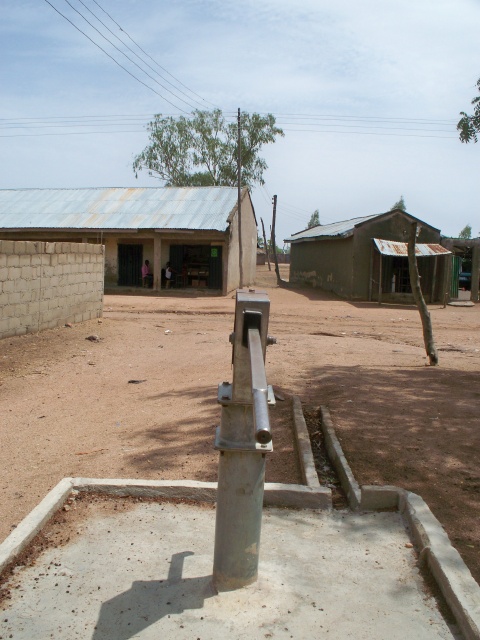
I should introduce myself for those who do not know me. I am Jay Johnson. I am a professional engineer. I am a retired Lt. Colonel from the US Army and Army Reserve. I have traveled extensively in my military and professional careers. Since 2006 I have been traveling to Nigeria annually. The first two trips were short two week visits with the Minneapolis Areas Synod / Global Health Ministries Public Health Evaluation Team. Starting in 2008 I visited by myself for visits of 6 week to 10 weeks. In 2008 my purpose was to start learning the people and culture. I visited all the Dioceses of the Lutheran Church of Christ in Nigeria and over 100 villages. This is when I composed my three priorities for village water. 1. A village wants to have enough water to survive. 2. They want the water as close to their village as possible. 3. They want safe water.
The Lutheran Church of Christ in Nigeria is based out of Adamawa State. Adamawa is a rural state in the northeast part of Nigeria on the border with Cameroon. It is mostly savannah. Deforestation is almost complete except in a few preserves and hillsides too steep to farm. They have two seasons. Dry season is from October to June. Rainy season is from June to October. In the southern part of the state the rainy season is longer and in the northern area it is even shorter. In the capital Yola the annual rainfall is about the same as Minneapolis. Except it is concentrated in a short period of time. Farming is mainly a rainy season business. We have had several rainfalls and the countryside is turning green. The vacant farm fields are now busy with people with hoes, or cattle pulling plows and tractors plowing. The sorghum has sprouted in some areas and the maize is being planted. On weekends the people from the cities head to their villages and plant their crops.
My original purpose in coming to Nigeria was to start my retirement career as a non-denominational water, sanitation and development consultant. All of my trips have been centered on clean water and sanitation, but have included work in community development. The three main organizations I work with are the LCCN Health Board Water and Sanitation/Hygiene (WASH) Team, the LCCN Deaf Centre and Spring of Hope HIV/AIDS Support Group. Over 90 percent of my efforts are with clean water.
This trip had a slow start as my main contact Yakubu Bulama the Water Coordinator for the Health Board and Projects Coordinator for the LCCN was working with the Health Board Administrative training for the first two full weeks I was in the country. I spent these weeks setting household in the old mission house on the LCCN Compound and visiting with the Deaf Centre. The guards at the Cathedral Church in the adjoining compound called my house the "falling down house."
My travels this 10 weeks has probably totaled around 4,000 kilometers (2,500 miles) by road in public transportation and in LCCN owned vehicles. This was the most dangerous part of my time. Many of the drivers are not licensed. Some went from riding bikes to driving cars. Others drove motorbikes and drive their cars the same way. Few know the rules of the road. When I got my license I paid an extra 1,500 Naira ($10) so I did not have to talk to the driving examiner. The manager just gave me my license and told me that was what the extra money was for.
Water accomplishments: There are more accomplishments than disappointments. Some of the disappointments are actually accomplishments (or steps towards accomplishments.) The main two accomplishments were fixing the water distribution system at Banjiram and drilling two productive boreholes at Waya and a third at Polchi. (Waya and Polchi are in Bauchi State and are mission villages of the LCCN churches in Jos, Plateau State). We also were able to go to Timbukum, in the southern part of Adamawa State to start the review of the non-functional solar powered borehole that the Nigerian Government with money from the US Government had installed and never worked. We found that the pump was installed at the very top of the water table. The next phase which will do done after I leave will be to determine if the borehole is deep enough to lower the pump to under the water. We be a preliminary survey of the broken water system at the Government Secondary School in Hong that the PTA had asked for our assistance. In Pella we got to review the large hand dug well near the LCCN Maternity Clinic to determine the possibility and estimated cost to clean out the bottom of the well, cover the well and add a hand or powered pump. This is a highly productive well that has had continuous water for several decades. The water was over 6 feet deep. The hardest part of this project will be to find pumps capable of de-watering the well so the well diggers can enter and remove the several decades of debris that has accumulated.
Disappointments: We performed a geophysical survey of two points in the community around the Sabon Gari B District Church on the edge of Mayo Belwa. The survey indicated that there was not a significant amount of groundwater for a productive borehole at the two locations surveyed. However, there are several productive motorized boreholes operating in the area. The next thing for the community to do is to go to the owners of the productive boreholes and find out how deep they are and if possible measure the static and dynamic water levels. Likewise, the geophysical survey of the area where they want to install a borehole at Gada Biyu in Bauchi State found very little indication of groundwater. We have asked the geologist if an improved hand dug well might be possible. This village may require some more innovative system for obtaining water during the dry season.
Other Work: LCCN Deaf Centre is moving towards being able to serve more of the Deaf Community of Adamawa. Last week the Yola Bishop requested that the paperwork for the Ordination of Ruth Ulea as the first deaf pastor in the LCCN be forwarded to the Jimeta District Church. By tradition a candidate's home district is suppose to call pastors.Ruth's home church is in Arewa Diocese in Hong. They have sat on her application because she does not serve their community and for some other reasons. The LCCN Constitution on specifies that a District Church will call a pastor. In Ruth's case she provides Sunday School and church services in Jimeta and several other locations in the Yola Diocese. We fixed most of the roof leaks in the patio area where Ruth holds Sunday Services and I bought 7 sets of jewelry and some bracelets that some of the women make to support the Centre. They normally sell them for 300 naira in the local market. I talked them into sell them to me for 500 naira. I will be putting them up for bid on a website for a minimum of $10 (1,570 naira) with the profits going back to the Centre. I have started work on some concept designs for improvements to the LCCN Deaf Centre and improvements to the location that Church services are held at until a new church can be located, designed, financed and built. I was able to attend a meeting of the Spring of Hope HIV/AIDS Support Group. A part of the group has been trained in soap making. They only need $400 to buy the molds and ingredients for their first batch of soap. They have test marketed some of the soaps in their home villages and found that market to be more viable than in the more competitive Yola market. I hope to raise the $400 as a micro-loan when I get back to the US. I have made progress on fixing my "falling down house". The main opening that rats and mosquitoes come in through has been screened. There are two major roof problems that are washing away some of the mud bricks in the kitchen wing that will need attention soon or the kitchen wing will fall down. For the first time in the last three trips I have been able to stop and shop at Women of Hope store in Jos. I will be leaving the country broke but I purchased 71,000 naira of their merchandise. It will be for sale at the Mount Calvary Annual Fair Trade Fair the first weekend of November. I have a great tan from the elbows down and since I have driving the last month the left arm is now balanced with my right arm.
I almost forgot. After three years of sitting in Gaye Guyton's living room. The boxes of books that were collected for the Remi Foundation, the books I collected for the Bronnum Lutheran Seminary and the LCCN Deaf Centre arrived in Jos and I picked them up Saturday when we were there for the Waya borehole drilling. They were all distributed on Monday. The Deaf Centre library went from about a dozen books to almost 100. They are considering allowing the students to take some of the books home to read overnight. I have been in locked libraries at schools. Most schools to not have a library at all. The Jimeta Cathedral school has a room in their new expansion designated for a library but does not have books. The culture of reading is very small. Most students only read text books and some have workbooks.