I was asked to write a Reader's Digest version of my last 2 1/2 months in Nigeria for a newsletter. I figured I would write a summary blog on my last day here. I am mostly packed and ready to head to the airport in about 5 hours. In all this was a successful trip. There were some frustrations. I had delayed my trip a few weeks so I would arrive after the Health Board had there two weeks of administrative training. Their training got delayed two weeks. At the end of the trip there was problems with transferring money to a driller and that delayed the drilling of the Waya borehole to the very end of the trip.
I should introduce myself for those who do not know me. I am Jay Johnson. I am a professional engineer. I am a retired Lt. Colonel from the US Army and Army Reserve. I have traveled extensively in my military and professional careers. Since 2006 I have been traveling to Nigeria annually. The first two trips were short two week visits with the Minneapolis Areas Synod / Global Health Ministries Public Health Evaluation Team. Starting in 2008 I visited by myself for visits of 6 week to 10 weeks. In 2008 my purpose was to start learning the people and culture. I visited all the Dioceses of the Lutheran Church of Christ in Nigeria and over 100 villages. This is when I composed my three priorities for village water. 1. A village wants to have enough water to survive. 2. They want the water as close to their village as possible. 3. They want safe water.
The Lutheran Church of Christ in Nigeria is based out of Adamawa State. Adamawa is a rural state in the northeast part of Nigeria on the border with Cameroon. It is mostly savannah. Deforestation is almost complete except in a few preserves and hillsides too steep to farm. They have two seasons. Dry season is from October to June. Rainy season is from June to October. In the southern part of the state the rainy season is longer and in the northern area it is even shorter. In the capital Yola the annual rainfall is about the same as Minneapolis. Except it is concentrated in a short period of time. Farming is mainly a rainy season business. We have had several rainfalls and the countryside is turning green. The vacant farm fields are now busy with people with hoes, or cattle pulling plows and tractors plowing. The sorghum has sprouted in some areas and the maize is being planted. On weekends the people from the cities head to their villages and plant their crops.
My original purpose in coming to Nigeria was to start my retirement career as a non-denominational water, sanitation and development consultant. All of my trips have been centered on clean water and sanitation, but have included work in community development. The three main organizations I work with are the LCCN Health Board Water and Sanitation/Hygiene (WASH) Team, the LCCN Deaf Centre and Spring of Hope HIV/AIDS Support Group. Over 90 percent of my efforts are with clean water.
This trip had a slow start as my main contact Yakubu Bulama the Water Coordinator for the Health Board and Projects Coordinator for the LCCN was working with the Health Board Administrative training for the first two full weeks I was in the country. I spent these weeks setting household in the old mission house on the LCCN Compound and visiting with the Deaf Centre. The guards at the Cathedral Church in the adjoining compound called my house the "falling down house."
My travels this 10 weeks has probably totaled around 4,000 kilometers (2,500 miles) by road in public transportation and in LCCN owned vehicles. This was the most dangerous part of my time. Many of the drivers are not licensed. Some went from riding bikes to driving cars. Others drove motorbikes and drive their cars the same way. Few know the rules of the road. When I got my license I paid an extra 1,500 Naira ($10) so I did not have to talk to the driving examiner. The manager just gave me my license and told me that was what the extra money was for.
Water accomplishments: There are more accomplishments than disappointments. Some of the disappointments are actually accomplishments (or steps towards accomplishments.) The main two accomplishments were fixing the water distribution system at Banjiram and drilling two productive boreholes at Waya and a third at Polchi. (Waya and Polchi are in Bauchi State and are mission villages of the LCCN churches in Jos, Plateau State). We also were able to go to Timbukum, in the southern part of Adamawa State to start the review of the non-functional solar powered borehole that the Nigerian Government with money from the US Government had installed and never worked. We found that the pump was installed at the very top of the water table. The next phase which will do done after I leave will be to determine if the borehole is deep enough to lower the pump to under the water. We be a preliminary survey of the broken water system at the Government Secondary School in Hong that the PTA had asked for our assistance. In Pella we got to review the large hand dug well near the LCCN Maternity Clinic to determine the possibility and estimated cost to clean out the bottom of the well, cover the well and add a hand or powered pump. This is a highly productive well that has had continuous water for several decades. The water was over 6 feet deep. The hardest part of this project will be to find pumps capable of de-watering the well so the well diggers can enter and remove the several decades of debris that has accumulated.
Disappointments: We performed a geophysical survey of two points in the community around the Sabon Gari B District Church on the edge of Mayo Belwa. The survey indicated that there was not a significant amount of groundwater for a productive borehole at the two locations surveyed. However, there are several productive motorized boreholes operating in the area. The next thing for the community to do is to go to the owners of the productive boreholes and find out how deep they are and if possible measure the static and dynamic water levels. Likewise, the geophysical survey of the area where they want to install a borehole at Gada Biyu in Bauchi State found very little indication of groundwater. We have asked the geologist if an improved hand dug well might be possible. This village may require some more innovative system for obtaining water during the dry season.
Other Work: LCCN Deaf Centre is moving towards being able to serve more of the Deaf Community of Adamawa. Last week the Yola Bishop requested that the paperwork for the Ordination of Ruth Ulea as the first deaf pastor in the LCCN be forwarded to the Jimeta District Church. By tradition a candidate's home district is suppose to call pastors.Ruth's home church is in Arewa Diocese in Hong. They have sat on her application because she does not serve their community and for some other reasons. The LCCN Constitution on specifies that a District Church will call a pastor. In Ruth's case she provides Sunday School and church services in Jimeta and several other locations in the Yola Diocese. We fixed most of the roof leaks in the patio area where Ruth holds Sunday Services and I bought 7 sets of jewelry and some bracelets that some of the women make to support the Centre. They normally sell them for 300 naira in the local market. I talked them into sell them to me for 500 naira. I will be putting them up for bid on a website for a minimum of $10 (1,570 naira) with the profits going back to the Centre. I have started work on some concept designs for improvements to the LCCN Deaf Centre and improvements to the location that Church services are held at until a new church can be located, designed, financed and built. I was able to attend a meeting of the Spring of Hope HIV/AIDS Support Group. A part of the group has been trained in soap making. They only need $400 to buy the molds and ingredients for their first batch of soap. They have test marketed some of the soaps in their home villages and found that market to be more viable than in the more competitive Yola market. I hope to raise the $400 as a micro-loan when I get back to the US. I have made progress on fixing my "falling down house". The main opening that rats and mosquitoes come in through has been screened. There are two major roof problems that are washing away some of the mud bricks in the kitchen wing that will need attention soon or the kitchen wing will fall down. For the first time in the last three trips I have been able to stop and shop at Women of Hope store in Jos. I will be leaving the country broke but I purchased 71,000 naira of their merchandise. It will be for sale at the Mount Calvary Annual Fair Trade Fair the first weekend of November. I have a great tan from the elbows down and since I have driving the last month the left arm is now balanced with my right arm.
I almost forgot. After three years of sitting in Gaye Guyton's living
room. The boxes of books that were collected for the Remi Foundation,
the books I collected for the Bronnum Lutheran Seminary and the LCCN
Deaf Centre arrived in Jos and I picked them up Saturday when we were
there for the Waya borehole drilling. They were all distributed on
Monday. The Deaf Centre library went from about a dozen books to almost
100. They are considering allowing the students to take some of the
books home to read overnight. I have been in locked libraries at
schools. Most schools to not have a library at all. The Jimeta Cathedral
school has a room in their new expansion designated for a library but
does not have books. The culture of reading is very small. Most students
only read text books and some have workbooks.
This is my blog about my annual trip to Nigeria to assist the Lutheran Church of Christ in Nigeria. I have been coming here since 2006. If you add up all the weeks from my seven trips I have been here 8 months.
Showing posts with label Jimeta. Show all posts
Wednesday, May 23, 2012
Monday, April 30, 2012
Met A Philosopher Today and Some Pictures
Meet Isaac Bolingo. Christian Philosopher
Today I walked up to the Main Market to get information on three wheeled motorcycle based utility vehicles. I no longer take water along with me on these treks. I stop and buy it as I go. I noticed a shop with a lot of water outside and asked the man if he had cold Faro water. He looked up at me from where he was sitting with his one eye, smiled and said "Yes". He went inside the shop to a box freezer and got a fairly cool bottle of water for me. I gave him a 100 Naira bill. He did not have change and went to the next shop to get change I looked down at the note pad he had be writing on.
"Touch Time Never Lasts
But
Touch People Do"
"Who Care For Who, When
Who is Who"
When he came back I asked "Are these your thoughts." He said "Yes". I shook his hand and told him that I liked his thinking.
| Marvelous and Dad |
| Marvelous and Mom |
This is the first year I have seen these here. I have seen them in Korea and in Thailand. Now it appears they are available here. The used dealer told me he can get the new version from Kano for 380,000 Naira ($2,533). These used ones go for 280,000 Naira. My thoughts are these would be useful as borehole repair vehicles. We could add locking tool boxes, and rack to carry pieces of riser pipes, a winch, and maybe a hoist assembly of some sort to pull pipe with. If we get the more robust rear end (Everyone needs a robust rear end.) and other modifications I am guessing the price will be near $4,000.
Saturday was the monthly meeting of the Spring of Hope HIV/AIDS Support Group. I missed their March meeting and will leave before their May meeting. I got there a little early and this little girl was playing with a lady at the back of the room. I sat down against the wall. She wandered up to her mother who was seated across from me and then turned and looked at me. She screamed and ran back to the other lady. I was not the first white man she had seen but she was surprised by me. Everyone tried to get to stop crying and nothing worked. The took her into the office where other kids were playing with toys and she cried for about another 5 minutes. I put my phone around the corner of the door and took a picture of the kids. They are playing with a cheap version of Legos.
Farah James is the Director of Spring of Hope. Today she was giving a talk on Malaria for the end of the International Malaria Week. People with HIV/AIDS are more likely to die of Malaria than most people. She emphasized the importance to sleeping under LLIN (Long Lasting Insecticide-treated Net). These new nets are expected to last 5 years since the insecticide is built into the fibers of the threads the nets are made of rather than being treated after the net were made. As she talked the kids would wonder out of the office behind her and play around her feet.
Those of you who have followed the HIV/AIDS epidemic have probably heard of "ABC". Abstinence, Be Faithful, and Condoms. Now there is SAVE. Safe Practices, Access and Availability to Treatment and Nutrition, Voluntary Counseling and Testing, Empowerment. Click on the picture and you can try to read the bigger version of the poster.
The group was less than half of the normal group. This is wedding season in Adamawa. Easter to June is the favorite time to get married. Do not ask me why, I did not ask. Most of the people are at weddings and half of the people who were here are going to a wedding after the meeting. That is why the little girl is in such a fancy dress for Saturday morning. Farah also announced that the first line HIV/Aids drugs are now going to be available in Adamawa. The had been available to those who could afford them but now the manufacturers have given discounts and the government has provided subsidies for the poor. Wow poor people who cannot find work because of the on-going stigma of HIV can now get the same life-saving drugs that he "big" people can buy. Actually, if the big people go to the government clinic they will get it free also. HIV is an equal opportunity killer if you do not ABC and SAVE.
This is Ruth Ulea. She lost her hearing as a teenager. Her father was stationed near the Christian Mission for the Deaf of Nigeria school,. He met Dr. Andrew Jackson Foster who after teaching her American Sign Language encouraged her to get theological training. When Dr. Foster died she returned to Yola and eventually, enrolled at Bronnum Lutheran Seminary. She graduated in 1994. Most of her classmate were ordained, one is now the Yola Bishop and one is the head pastor at the Cathedral. She has not been ordained. But since 1994 she has been providing Sunday School and a non-denominational Sunday Service, first in Jada
Government School for the Disabled and now at the LCCN Deaf Centre and in two other communities. The Yola Bishops have always found a lame excuse for not ordaining her and have not provided any help to overcome their objections. So in Adamawa the deaf are not Lutheran.
I may have already published this picture. But I like it. This is one of the kids of one of the women that was attending the Easter Camp for the Deaf that was held around my house. That is my front porch in the background.
I have just about used up the fuel in my generator while writing this and a few other things. Time to shut down and get some sleep.
Sunday, April 8, 2012
Waya - Long Trip - Several Challenges
I written and re-written this blog a few times. It is always too long. I get too much into the technical details that would interest the people on the Minneapolis Area Synod, Water Committee but not what regular people would be interested in. Yes guys you are not regular people.
We started the trip to visit Waya from Jimeta in Adamawa state on Monday morning April 2. We traveled through Numan and up to Gombe where we stopped for lunch at a roadside cafe near the bypass junction. Clean place and the three of us ate for 850 Naira ($5.40). It was a quick lunch. Then back on the road for Jos. We had arranged for a 6:30 dinner meeting for the pastors, mission committee members and the driller from Jos. I was called on our way to Bauchi and asked to hold the meeting at 5:00 PM so people can get home before it got dark. The security situation in Jos makes travel at night difficult. I checked with Yakubu and my GPS, both said we will make it in time. We moved the meeting to 5:00.
As we were going through the railroad crossing on the east edge of Bauchi, a group of young men in safety vests, tossed boards with nails in them into the road and signaled us to pull over. We did. They told us they worked for the local government and were inspection vehicle certifications. This is a national program which authorizes the local government to certify vehicles and issue decals for the Local Government, State Government, Federal Government and other groups. Adamawa State was not yet doing this. We told them we were from Adamawa and would get the certificates when we returned. They said we could not pass until we paid 25,000 naira ($160). Yakubu told them we do not have that kind of money and explained to them that we were NGO's and were working on drilling boreholes in Bauchi State so their people could have water. That they had educated us and we should now go. The young men were firm they wanted their Naira. We asked for their identification. They refused. We said OK one of you get in we will go to your office. They said no not until 4:00PM. We got out and hailed a taxi to go to the Bauchi Local Government offices. There we discovered the boys were working for a contractor for the local government tax collector. After an hour of arguing the head of the tax department called the contractor and asked him to come over. We ended up paying only 15,000 Naira and got the stack of certificates. Now it will be hard to get to Jos by 6:30.
We had our meeting with the District Pastor and the the District Church Mission team. Waya was not a concern to them. Then wanted to know when we were to start drilling in Polchi and Gadabiyu. I have not visited Polchi but did visited Gadabiyu last year. They said that the money for boreholes had been donated and they wanted the boreholes drilled. Yakubu explained the procedures to do the work. That the Water Team was part of the Medical Board now and the objective is to improve the health of the village. The village has to be prepared and have to agree on providing part of the funding, agree to maintenance, agree to sanitation and hygiene training and agree to building of VIP latrines if they do not have latrines in the village. They said the Danes did not have these requirements. The Danes do not require the village to give any naira just collect sand and give labor. We explained that our experience over the past five years is that naira was precious and labor or sand were of little value. If the village wanted to be part owners of the project they would donate a little naira. If they donate naira they will feel like they own it and will maintain it. I told them that we are not the White Man coming to help the Poor Nigerian. The Nigerian can help himself and we would help but we will not pay everything. The mission chairman seemed to understand but I do not think I made a friend of the District Pastor. It was now near 8 pm and the generator had little fuel. We arranged to meet the Catechist from Gadabiyu as our guide to Waya the next morning. We checked into our rooms to discover the water tank was empty that supplied the rooms and the barrels in the rooms were also empty. So we fetched water from the hand pump down by the main house and shared the little drinking water that was in our rooms. The next morning they turned on the generator and pumped water to the tank after we were at breakfast.
The next morning we were to meet the geologist at 8 to leave for Waya. They were there at 7. I am impressed with them. So far everything they have done has been professional and timely. Of course they wanted to leave and we wanted to eat breakfast. We did not know when our next meal will be. While we were eating they went to get camera batteries. We finished breakfast and needed to buy a little oil for the truck. The water truck is a 1995 Toyota Hi-Lux with a rebuilt 2.8 liter diesel engine. The only size of diesel engine oil the Total Station had was 4 liters. As we added the oil, the geologist called and we told them where we were. We joined up and then got another call. The Grace and Light Mission people had arrived back at Dogan Dutse Guest House with HIV test kits for their Yola office. We told them where we were and waited for them. The test kits were quite useful at the check points. When the soldier or police man asked what was in the bag and we said HIV test kit. He would look at me and I assume he assumed I was a doctor and would wave us through. Much easier than when our clothes or computer bags were on top of the piles.
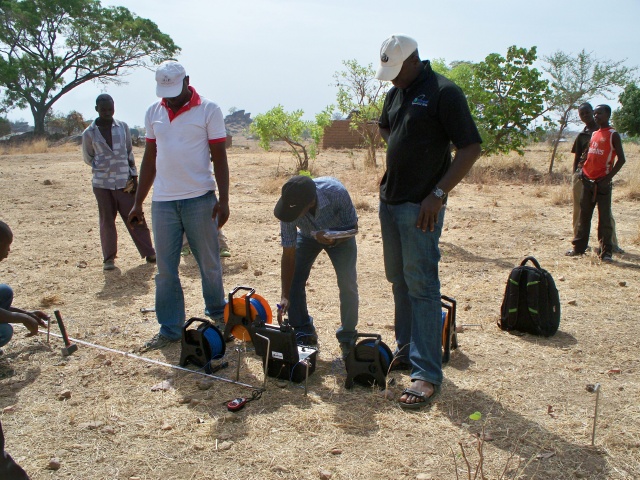
We spent the whole day at Waya while the geologist performed
surveys at six site. I spent most of the time in shade. In spite of SPF 30 sun
screen my arms and neck got a little burned. This sun here is SPF 60. I had
brought along a red and white checkered cloth. I soaked it in water and put it over
my head to cool me and to protect my neck. I was told I looked like Yassar
Arafat. As I walked up to the drillers they joked they thought that Al-Qaeda
was coming. The kids would come to see the Batura but would not get close to
me. For many of them I was the first white man they had seen. Others had seen
me last year and Gary last fall. But they still would not get close to me until
it was time for a picture.
The bad news is that the hydro-geology of the area does not look good. The basement rock is pretty solid and appears that the water is in the overburden and it the top few meters of the basement where the rock was weathered many centuries ago before it was buried. The plan is to drill through the weathered rock down into the solid material to make a reservoir to pump from. We will get the cost estimate for the work next week. We had hoped to find a site capable of handling a future solar powered borehole. But the rock fractures do not go deep. Even the hand pump may run dry. This is a site that my benefit from small check dams in the streams to force more water into the earth. The pro is a higher water table and less erosion. The con is that some loss of farm land could happen.
We started the trip to visit Waya from Jimeta in Adamawa state on Monday morning April 2. We traveled through Numan and up to Gombe where we stopped for lunch at a roadside cafe near the bypass junction. Clean place and the three of us ate for 850 Naira ($5.40). It was a quick lunch. Then back on the road for Jos. We had arranged for a 6:30 dinner meeting for the pastors, mission committee members and the driller from Jos. I was called on our way to Bauchi and asked to hold the meeting at 5:00 PM so people can get home before it got dark. The security situation in Jos makes travel at night difficult. I checked with Yakubu and my GPS, both said we will make it in time. We moved the meeting to 5:00.
As we were going through the railroad crossing on the east edge of Bauchi, a group of young men in safety vests, tossed boards with nails in them into the road and signaled us to pull over. We did. They told us they worked for the local government and were inspection vehicle certifications. This is a national program which authorizes the local government to certify vehicles and issue decals for the Local Government, State Government, Federal Government and other groups. Adamawa State was not yet doing this. We told them we were from Adamawa and would get the certificates when we returned. They said we could not pass until we paid 25,000 naira ($160). Yakubu told them we do not have that kind of money and explained to them that we were NGO's and were working on drilling boreholes in Bauchi State so their people could have water. That they had educated us and we should now go. The young men were firm they wanted their Naira. We asked for their identification. They refused. We said OK one of you get in we will go to your office. They said no not until 4:00PM. We got out and hailed a taxi to go to the Bauchi Local Government offices. There we discovered the boys were working for a contractor for the local government tax collector. After an hour of arguing the head of the tax department called the contractor and asked him to come over. We ended up paying only 15,000 Naira and got the stack of certificates. Now it will be hard to get to Jos by 6:30.
We had our meeting with the District Pastor and the the District Church Mission team. Waya was not a concern to them. Then wanted to know when we were to start drilling in Polchi and Gadabiyu. I have not visited Polchi but did visited Gadabiyu last year. They said that the money for boreholes had been donated and they wanted the boreholes drilled. Yakubu explained the procedures to do the work. That the Water Team was part of the Medical Board now and the objective is to improve the health of the village. The village has to be prepared and have to agree on providing part of the funding, agree to maintenance, agree to sanitation and hygiene training and agree to building of VIP latrines if they do not have latrines in the village. They said the Danes did not have these requirements. The Danes do not require the village to give any naira just collect sand and give labor. We explained that our experience over the past five years is that naira was precious and labor or sand were of little value. If the village wanted to be part owners of the project they would donate a little naira. If they donate naira they will feel like they own it and will maintain it. I told them that we are not the White Man coming to help the Poor Nigerian. The Nigerian can help himself and we would help but we will not pay everything. The mission chairman seemed to understand but I do not think I made a friend of the District Pastor. It was now near 8 pm and the generator had little fuel. We arranged to meet the Catechist from Gadabiyu as our guide to Waya the next morning. We checked into our rooms to discover the water tank was empty that supplied the rooms and the barrels in the rooms were also empty. So we fetched water from the hand pump down by the main house and shared the little drinking water that was in our rooms. The next morning they turned on the generator and pumped water to the tank after we were at breakfast.
The next morning we were to meet the geologist at 8 to leave for Waya. They were there at 7. I am impressed with them. So far everything they have done has been professional and timely. Of course they wanted to leave and we wanted to eat breakfast. We did not know when our next meal will be. While we were eating they went to get camera batteries. We finished breakfast and needed to buy a little oil for the truck. The water truck is a 1995 Toyota Hi-Lux with a rebuilt 2.8 liter diesel engine. The only size of diesel engine oil the Total Station had was 4 liters. As we added the oil, the geologist called and we told them where we were. We joined up and then got another call. The Grace and Light Mission people had arrived back at Dogan Dutse Guest House with HIV test kits for their Yola office. We told them where we were and waited for them. The test kits were quite useful at the check points. When the soldier or police man asked what was in the bag and we said HIV test kit. He would look at me and I assume he assumed I was a doctor and would wave us through. Much easier than when our clothes or computer bags were on top of the piles.
Waya is a small
village that was visited by a pastor from North Dakota a number of years ago.
He was disturbed at the water the people were drinking. He decided he cannot
help everyone in the world but he can help this one village. He has now
contributed enough money to install two boreholes, two VIP latrines and provide
sanitation/hygiene training in the village. VIP latrines are Ventilated
Improved Pit latrines (not Very Important People latrines). The LCCN water program is part of the overall medical
efforts of the LCCN to reduce illness and preventable deaths. Clean water at the
water source by itself has a little effect on health. Clean water that is kept
clean by proper sanitation and hygiene efforts have a greater effect. Hand
washing, proper food handling and using a VIP latrine (followed by hand
washing) will have the greatest effect on the health of the village. Sanitation
and hygiene are harder to sell to the villages and the churches supporting the
villages. Borehole water is seen as a status symbol and the cause and effect
are immediate. When you are thirsty you drink water and quench your thirst. But
for sanitation and hygiene the link between disease and sanitation is more
remote and less easy to understand. When you get sick today it is harder to
understand that it was caused by something you eat or drank up to 3 days ago.
As long as I am up on my “Soap Box”, here is Jay’s understanding of the water
priority for people living in rural villages: 1. Be able to collect enough water to live. 2.
Have a water source as close to where you live and farm so you do not spend all
day just collecting water. 3. Have clean water.
| Hand dug well that is nearly empty. The water is muddy. Other hand dug wells had more water and were clear. |
The village is split by a stream that floods during the
rainy season. A single borehole would only help one side of the village. I
changed my travel routine last year and visited the village on my way into Nigeria.
Instead of flying from Abuja to Yola, I went by land and stayed a few day in
Jos. The Jos District Church is the church that has worked with Waya in the past. The two
churches in Waya are part of the Jos Distirct. Due to some confusion last year
about two Pastor Emmanuels in Jos I was only able to visit Waya for a short time on a
Sunday afternoon. I did not get in contact with the correct Pastor Emmanuel
until Friday evening. During my brief visit I performed an initial survey and later
created a draft project description and initial budget. It was 10% higher than
the pastor had intended to donate. He said no problem, he can find another
$1000.
Yakubu and Gary Sande from Global Health Ministries visited Waya last
fall after the donor’s conference in Jos. They visited three villages. Waya and
the two current mission out-reach areas of the Jos District (Gadabiyu anbd Polchi). Like my trip,
their visit was brief in each village and they were not able to talk with the
chief about the requirements of village participation, maintenance, sanitation
and hygiene. I only visited 2 villages the third was too far for an afternoon
visit. They started earlier and went to all three with the furthest village
last and took back roads to Bauchi from there. They arrived late into the evening and
totally worn out by the long day of driving on bad dirt roads.
We arrived at the less populated side village where the
older Church is located with the driller, three geologists and their helper.
We explained to the geologist that we did not want the borehole sited at the
church because the Muslim part of the village would not use it. The geologist
looked over the area and decided on three potential sites. While they were
starting the geo-physical survey Yakubu went to the other side to speak with
the chief. The chief had heard of the project and the village would be glad to
participate. Wherever the geologist decide to put the borehole he will talk
with the owner of the land and make sure they understand that it is a
community borehole and he as chief fully supports the project.
The bad news is that the hydro-geology of the area does not look good. The basement rock is pretty solid and appears that the water is in the overburden and it the top few meters of the basement where the rock was weathered many centuries ago before it was buried. The plan is to drill through the weathered rock down into the solid material to make a reservoir to pump from. We will get the cost estimate for the work next week. We had hoped to find a site capable of handling a future solar powered borehole. But the rock fractures do not go deep. Even the hand pump may run dry. This is a site that my benefit from small check dams in the streams to force more water into the earth. The pro is a higher water table and less erosion. The con is that some loss of farm land could happen.
| Little girl posed for me. I took several picture before a got a good exposure and good smile. |
We ended the day at Bauchi with a visit to the Bauchi Church
to talk to them about their project with Redeemer Lutheran of Minneapolis.
Their companion congregation has raised enough money to install one borehole.
The Bauchi Church has a mission field of six villages. All have similar
problems with water. They want to put in six hand
dug wells instead of one borehole. Gamakesa from the LCCN Rural Development Department had spent the previous day visiting all the sites. He will give us a cost estimate for the six hand dug wells with concrete walls, concrete covers and
hand pumps after Easter. In general a properly built hand dug well is about half the cost of the borehole. The money that is
available for their project will not cover 6 hand dug wells. They seemed to think that this was not a problem that Redeemer will furnish the funds. Yakubu went through the same conversation about participation that we had the previous evening in Jos. Then I told them that I was familiar with Redeemer Lutheran. That they are a small church in the poor part of Minneapolis. That they had worked hard for several years to save enough money for one borehole. I explained that Redeemer are involved with many programs in their own community. They feed the poor. They provide housing. They have youth programs and many other programs to help the poor in their community. Many of their members are poor themselves. They are a very active church that stretches their financial resources to the limits to help their neighbor in Nigeria and in America. It was hard for them to raise the money they have raised so far and do not expect that they will be able to quickly raise more money. (Sorry, my friends at Redeemer if I misrepresented you.) They were impressed that their companion was such an active church helping the poor. It probably is not my place to give the people a reality check. I have to be honest. People are always asking me to drill them a borehole. I look them in the eye and say "No". After their shocked expression goes away I tell them that "I will help you build your own borehole. Nigerians are capable of making their own boreholes. They do not need me or any other American to do it for them. We can help them by they must do it themselves."
Wednesday morning we left Bauchi headed home. Stopped at the Bauchi Church to say good bye to the Dean. His wife had hot water for tea and coffee ready for us and fried Irish potatoes. The night before he had said something about Irish and I heard coffee. I missed him saying potatoes. I asked if he was going to give us Irish Coffee? He knew what Irish Coffee was and laughed and said Irish potatoes. Yakubu did not know about Irish Coffee and did not know what was so funny. Adams, the Dean and I were laughing and poor Yakubu was wondering what the joke was. I explained it is coffee with alcohol. He asked they add a little alcohol to their coffee. We laughed again and said no, not a little. The Irish add a lot. (Sorry, my Irish friends but I have stereotyped you.)
As we were getting in the truck to head to Yola, Yakubu looked at his truck registration and insurance card. They had expired. We got past Gombe and we were stopped by the Gombe Vehicle Inspection Officers. Yakubu said "this will cost me." It cost us an hour and 7,000 naira. They had a manual typewriter with them and they typed up new registrations and new insurance papers on the spot. With as many people they had pulled over the wait was to get your turn with the typist. All very professional and official. Not like the young men in Bauchi. Like Bauchi any one with local plates were not inspected. We had plates from Plateau State.
Our final stop was in Lamurde. It was partially a waste of time. The Bible College was on holiday and the principal was not available. Global Health is interested in doing a borehole for the Bible College.The road from the main highway to Lamurde can hardly be called a road. Disconnected patches of asphalt. You spend more time on the dirt shoulder than on the road bed. Probably average 20 to 30 kilometers per hour. Finally, we stopped in Numan for an Nigerian lunch / dinner (pounded rice with okra soup and a little tuff meat. Got back to Jimeta before nightfall which is 6:30 this near the equator.
Monday, March 26, 2012
Pictures From This Week March 19 to 26
After the Commission the Yola Diocese Bishop installed the new District Pastor for the Jimeta District. Rev. Raymond Edwards. He is not the pastor at the Cathedral. The choir had a special song for the day and the Women's Fellowship had a song. The sermon started around 9:30 and Communion started around 10:15. Of the around 3500 people there many had left after the offering and maybe 2000 thousand were left for communion. The Pastor told them to be orderly and that not everyone can be first. So a majority jumped up into the aisles to get in line. They had several extra pastors present so they had three lines. I went back to the house for water and discovered that the power was on. I quickly plugged in all my electronics for recharging. Then went back to get in line. The service ended a little after 11 and so did the power.
On Saturday Yakubu, Teresa, the trainers from Kenya and I went to the market. I showed Yakubu the propane burner I wanted. He went to a vendor and got him down to 3500 naira. As of Saturday I had an empty propane burner. Monday Adams and I were to go to the Yola Diocese Bishop's new quarters to measure the depth of the water and depth of the borehole. Adams had to go to a government meeting on his pension. The government is trying to clear the roles of the deceased pensioners. The Diocese sent a bus (van) to pick me up. I got stuck in the sand by the house. They gathered guards and everyone else and pushed it out.
Unfortunately, the diocese had not asked Yakubu and Adams to be involved with choosing the driller or making sure the borehole was properly drill. It was drilled on a slant and I had a hard time getting a weighted tape measure down to the water. We have no idea the depth of the borehole. Today (Tuesday) we are suppose to pump test the borehole. I think we may not be able to accomplish this until we find out how deep it is. On our way back, we stopped and a cooking gas peddlers shop and filled the tank. He saw me and said 2000 Naira. I told him we will go to the market and fill it for 1500. He took the tank and filled it. Then he asked for 200 more. I gave him 100 more and he was happy.
Cooked chicken noodles on the new stove. Last night and this morning I will have my first hot oat meal breakfast.
Power lasted this morning from 4:15 to 7:05 enough time to reduce the pictures, upload them and write this post. I am going to publish it unedited. I edited it Tuesday night. There were not too many typos I found.
Thursday, March 22, 2012
March 22nd - LCCN Deaf Centre – Two people named Abdullahi
Earlier this week on my way to the market I stopped at the LCCN Deaf Centre to see if Ruth Ulea was there. The teacher who signed back that she was working off-site. I took this picture of the students, the teacher and a mother of one of the students.
Today Ruth and the teacher came over and I struggled to communicate with them. I only have two classes in ASL (over a year and a half ago) and the Nigeria ASL has been separate from the US ASL for many years. Like all languages this separation had created differences. Similar to the differences between Maine's version of English and Cajun English in rural Louisiana. This is a natural progression of language. When I was stationed with the Brits in Bosnia we had the same problem. The General I worked for would say “two peoples separated by a common language.” It helps that Ruth speaks and can lip read English and Hausa. She lost her hearing as a teen.
After they left I realized I had forgotten the teacher’s name. I had met him last year when he was home from Jos University where he was studying Special Education. I went over to the Centre and asked him to write down his name. Ishaya Yakubu. Class was over for the day and there where three kids left to have their parents come get them. Ishaya told the youngest child to sign something to me. I did not know and figured he was signing his name. My comprehension of finger spelling is slower than this little guy was going. I need more practice. He kept going and going. I got lost after about 15 letters and the last letter was Z. He had done the alphabet. He is the center kid in the picture in the row closest to the camera. He has the odd smile trying to imitate me as I tried to get the kids to smile for the picture. Say Cheese does not work. He looks lighter than the other kids for two reasons. He was closer to the door but also he is Fulani. Fulani are more light skinned. His name is Abdullahi Adamu.
Abdullahi was born deaf and living with the Fulani who are nomadic herders.
March 19th - Adip Hotel to the House
On Sunday I overslept and missed church services. The hotel is a short walk to Redeemer Lutheran. Early in the afternoon we found out that the trainers from Kenya have been delayed again. They had flown from Lagos to Abuja but because of the Harmattan dust cloud over Yola the planes were not flying in. They were sitting waiting for news at the domestic airport in Abuja. The news was bad. The flight was cancelled. Teresa contacted Bishop Benjamin. He arranged for them to be lodged at the Catholic Guest House near the airport. The current plan is that he will rearrange his schedule and drive to Yola on Monday with the trainers. If he cannot do this he will pay for a bus ride to Yola. He was coming to speak at the Gongola Diocese annual convention later in the week in Guyuk. If he drives them here, he will be a day early. The week long training has now been compressed to 4 days. Teresa and others called all the students who were not already on the road to come Monday afternoon instead of Sunday. Since they do not need the room I decided to stay another night.
It is now noon on Monday and we have not heard if the trainers are on their way. It is a long drive from Abuja. We are assuming that they are on the road somewhere.
| Yakubu on left, resting. |
| Market at one of the kitchen shops |
Yakubu came mid afternoon on Monday and picked up Teresa and me to buy 30 cases of water for conference and to take me over to the house. We also stopped at the Jimeta market for Teresa to buy some pots and pans. Numan is a small town with limited shopping. We got to the house around 4:30.
| Teresa & Yakubuat a bedding shop |
The Women’s Fellowship is practicing songs on the front porch. My front and back porches are favorite gathering places. There still was no water in the barrels. But the water sellers were still working at the borehole just outside the compound. We yelled to them to bring a cart of water. The house was cleaner than in past years but with the Harmattan dust it was still needed some work. I cleaned for a while and then decided check my food stores and walk to the store before it got too dark. The cans of vegetable salad I left here last year does not expire until this month. The nearby stores did not have dish soap so I walked about a mile to a Micoh Supermarket. A store of about 200 square feet inside and some outside storage of large items.
On the way back I stopped to buy some hard boiled eggs from a lady the peddles food outside the Specialist Hospital. She is one of around 20 peddlers selling to people who have family or friends in the hospital. She wanted to know what I brought her from America. She has been kidding me about taking to America for a couple of years. I keep tell her that my wife said I could not bring women home. She says I need two wives.
Back at the house I get out the IKEA solar light I brought along. Good thing I charged the battery. This year there is less power. The church had a fire and they hope to have repairs completed in time for Easter Sunday service. They had to replace the roof, all the ceiling tiles and the electrical system. These were all things that needed to be done but they were not bad enough to spend the money on. The fire is believed to been caused by a fault in the electrical system. When they are finished It will look like a new church inside.
Until the church is back running they will not be using their generator. I will be dependent on the Power Holding Company of Nigeria (NEPA). I washed all the dishes, rinsed them in a weak chlorine solution and set up the mosquito net, took my first cold shower and went to bed.
Saturday, March 3, 2012
Got to Amsterdam (Updated March 12)
![]() |
| Flight from Minneapolis to Amsterdam and on to Abuja |
| Things for other people. |
My flight leaves Sunday March 11th from Minneapolis to Amsterdam. It is a little over 8 hours and 7 hours of time changes. I have three hours in Amsterdam (long enough to loose my luggage.) then a 6 hour flight on KLM to Abuja. I arrive on Monday night a little later than I started. I have confirmed that someone from the Abuja Diocese will pick me up at the airport Monday night. Probably, my good friend Bishop Benjamin Fuduta. By the time I get to the ECWA guesthouse it will be near midnight.
I hope to spend a few days with someone from the Abuja Diocese to research pump and pump parts suppliers and have a discussion with the Abuja Diocese on their water, sanitation and development goals. In Abuja I will have 3G or 2G in most parts of the city.
From Abuja it looks like the water team from Yola will be working in the Bauchi area and I will hook up with them. Probably catch a ride to Jos first, then join them. Mr Yukubu Bulama has told me he has many projects waiting for me in Adamawa State.
One week while I am there I hope to drive over to Bali and visit Pastor Bunduku and the Bali Project over in Taraba State.
Jimeta has 2G internet (EDGE) over the cell phone most of the day, but will drop to 1G (GPRS) fairly routinely. At midnight the cell tower with internet shuts down to save generator fuel.
This is the first time with a smartphone in Nigeria. I should be able to post to Facebook from the phone. I will also be able to find out what level of internet is available in Bali and other remote areas. Probably will only be 1G.
Bad news is the Yakubu Bulama's US Visa was not approved. He said they were mostly approving immigrant visas and few of the business/tourist nonimmigrant. I am trying to organize an appeal for reconsideration. I found a FAQ about the visa that said you have to show significant economic and social ties to Nigeria. The application is not very good to that end. Yakubu certainly has those. Now how do we show that on his next application.
Subscribe to:
Posts (Atom)