Sunday, April 22, 2012

Timbukum Another Government Project That Does Not Work


Timbukum
Our day started early. Yakubu Bulama showed up at a little after 6 AM. He is driving his old Toyota van today. The Health Board is using the Hi-Lux to visit one of the Community Based Public Health Care (CBPHC) sites. They are doing community surveys of the villages around the Bingia and need the four wheel drive truck. We will be headed south to the village of Timbukum. It will be several hours of pothole dodging. The section of road from Mayo Belwa to Ganye is one of the worst in Adamawa. Not as bad as the Lamurda road but much longer. Each way will be nearly 4 hours. Our original plan was to drive down the night before, stop at Dashen Bible College to look at their pump problem. Stay overnight in Ganye and meet with the Bishop in the morning before driving the last hour down to Timbukum. We found out that the Bible College did not have a problem and the Bishop was going to Yola for a meeting. So we decided to make it a long day trip.
Roadside Food Stand

I was up at 5 to shower and make some breakfast. We stopped and got gas, cool water to drink and some engine coolant at a station on the edge of Yola and headed out of town. Yakubu and Adams had not had breakfast. So we stopped at the first village outside of Yola to buy some roadside eats. The lady had fried yams, fried sweat potatoes and bean cakes. We got a small bag of the combination of all three and headed on. Yams here are a large tubular without a lot of taste. 

Yakubu’s van is 16 years old. As you go up hill the temperature rises and as you go down is lowers. We had to stop once on the way there and once on the way back to let it cool down. The mechanics here do not believe in thermostats. Most vehicles have had them removed. They also do not add coolant just straight water. I told Yakubu that the coolant helps the radiator from boiling over. He had purchased some coolant when we stopped for fuel. He added it to the radiator when we stopped the first time. The engine is behind the front seat and the radiator and fan is between the driver and passenger seats

 We passed the Bonotem Bishop in Jada as we were finishing the bad part of the road and he was headed into it. We arrived in Timbukum around 10:15. I went to look at the old pump that was slow to recharge back in 2008 when I last visited here and found it was still slower now. When you stop pumping you can hear the water leaking out of the riser pipes. Yakubu could not find the church chairman but a white man walking around the village drew a crowd. We spent about a half hour talking to the people about the hand pump. Then we got directions to get to the solar powered borehole.

Timbukum is a village north of Toungo in the south end of Adamawa State. At the request of the local church through the Bonotem Bishop the village has requested assistance in finding out why the Millennium Development Goal solar powered borehole and tank does not deliver water. This is one of the government projects that the village did not know about until the driller showed up and started drilling. The borehole, tank and tap stand are located at the government Dispensary. If you click on the picture you will get a larger picture you can see better.
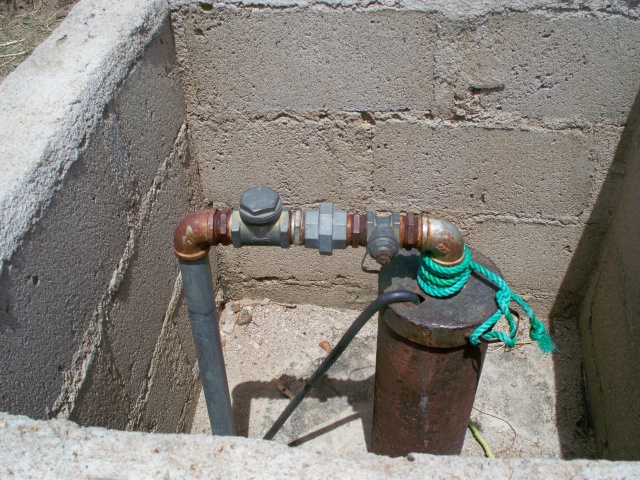
Upon arrival at the pump we could hear the distinctive sound of the pump trying to pump water and air. The people present reported that in the morning they get one or two buckets of water then it only drips all day. It appears that the pump is set at the water table rather than below. We found water at 70 feet with the water level indicator. We shut down the pump and waited a half hour. There was no significant recharge. Also, indicating the pump is set at the top of the water. We decided to pull the pump but discovered that the power cable does not have any slack. It enters the borehole through the cap and is cemented into the concrete base. To lift the cap and pull or add pipes to the pump will require the cable to be cut and additional cable spliced on. We did not have the additional cable or tools to do this work. We could not determine the depth of the borehole without removing the pump.
After listening to the pump I climbed the tower to see how the solar panels were connected to the pump. The wiring job was very professional, with all loose wires secured. The circuit breaker that I turned off at the top of the tank had never been switched off since it was installed in 2008. After switching off the pump I laid under the solar panels waiting to see if there was any recharge. After they determined that there was no significant recharge we decided to pull the pump. As I swung around to climb down the steel ladder I smashed my right shin on something. I climbed on down and then we discovered that we could not pull the pump. So I went back up to turn the pump back on. It did not want to turn back on. Yakubu climbed up with a screw driver and I disassembled the case and cleaned out are the wasp nests and mud wasps nests and still could not get the circuit breaker to stay in the on position. I removed one of the two plastic bars that were holding the two switches together and pushed as hard as I could and it finally clicked into position. We will be leaving with the pump working the same as before. No worse and no better.
Best Case: The best case for this project is that the borehole was drilled to over 100 feet deep and the pump can be lowered into the water by three or more pipe lengths (30 or more feet). Lowering the pump will provide more water above the pump to be pulled into the pump. The pump will draw the water down in the borehole causing the water in the ground to flow into the borehole. Pumps will operate best at a minimum of 3 pipes under the water table in an aquifer that is quick to recharge. In slower recharging aquifers the pump will need to be much deeper. There are indications from the other water sources in the area that this will be a slower recharging aquifer. If the pump can be lowered then a water level probe needs to be added to the pump to switch the pump off when the water level starts to reach the inlet to the pump. This will create a non continuous flow but will increase the pump life. Pumping air is not good for a pump.

Worst Case: The borehole is drilled to less than 100 feet and less than three pipes can be added. A new borehole will need to be drilled. The first step in this process will be to perform a geophysical survey of the area to determine the apparent depth to water and the thickness of the water. Unfortunately, the location of the tank tends to restrict the location of the borehole to a reasonable distance to the tank for pumping and electrical wiring. Based on a short review of the general geology of the area it is anticipated that the borehole will be drilled through a shallow layer of overburden and into weathered and hopefully fractured basalt or other volcanic formation. The area is shown on some maps as recent volcanic activity. Recent in geological time scale. If this is true than it is possible that below the volcanic formation can be layers of formations which could be contain significant water. Drilling through the assumed volcanic layer will be quite costly. The geophysical survey will provide a more accurate estimation of the hydrogeology of the area. Since the village never requested or were not consulted about the borehole they do not feel it is their borehole. They may not be willing to spend much money to fix the situation.

We left Timbukum around 1 pm and headed to Dashen Bible College. Earlier as we had crossed a bridge we saw some boys in the middle of the walkway of the bridge selling mangos. We stopped and bought mangos. The were selling them at 10 Naira each. Fresh and tree ripened. We each washed one off and eat as we drove to the Bible College.

Dashen Bible College provides education to Evangelist and Catechists and also has a Secondary School. They have posted some of the highest scores on their various levels of exams in all of Adamawa. Their PTA had raised money and drilled a borehole on the school grounds. They had not consulted with the WASH Team and hired a driller without doing any geophysical survey. The borehole was successful but they had some problems with the pump. Back in February the principal had asked Gary of Global Health Ministries for some help. This was the first chance that the WASH Team had to come down this way. In the mean time the pump had been repaired. 

 
After a short visit we headed back towards Jada. We drove around Jada looking for a place to eat. None of the spots we found looked to clean. We headed back out of town when I spotted a small spot with cooking pots out front. It was a two table restaurant. The kitchen is at entrance. That is Yakubu's van out parked outside. They had pounded rice with sauce or vegetables. I had the red sauce with a couple bits of beef and a almost cool Pepsi. The even had spoons, forks and knives in a basket at the table. We were not in Numan. (That is a story from last years blog. Eating at a restaurant in Numan we asked for a spoon and knife and the waitress said “This is Numan.” )


 We also had time to stop in Mayo Belwa to see the pump that we have been working with for the last three years. It appears to have a broken rod. There is a rather long story about this pump, bad driller, followed by bad driller, and then the water committee chairman making off with the funds. The use is so heavy on the pump that it tends to break a lot. There may be an alignment problem The second bad driller had trouble aligning the pump over the borehole and ended up taking a cutting torch to the tank to make it fit. Then kids through rocks through the opening and jammed the pump. This year the rod is broken. I would not be surprised to find debris in the pump again. I think they need a new tank and head. The profits from the 2008 fair trade sale at Mount Calvary were used to support this project. Part of the stolen money.

In all we had a successful day. I am fairly confident of our findings in Timbukum and it is now three days later and I have not gotten sick from the roadside meals. I no longer limp and the shin only hurts when I twist the knee.

Wednesday, April 18, 2012

Ngbekendiwe - New Water Source Proposal


Ngbekendiwe: Try to pronounce that three times fast.  The "Ng" is mostly silent. With my level of hearing loss it is silent. The name means “place where grains are stored”. The village asked the Todi Diocese for assistance and the Bishop referred the project to the Health Board WASH Program. This was the WASH Team’s third trip to the village (my first). The WASH Program emphasizes community participation. In many past projects the participation was limited to contributing a little labor and collect sands and gravels for the concrete. The WASH team has learned that this limited participation did not produce community ownership. Now they are requiring a minimum of 10% up-front cash. People get serious when Naira is involved. But they have never been asked by a church or the government to participate in this way. This is something new to them. The WASH Team tries to emphasize that they are not here to give a gift to the village but to help the village to build create a sustainable project that they will own and operate.

Small Store near the LCCN Church.
This is not a very poor village, but not a rich village either. It has small stores and other local conveniences.  The village structures are mostly made of mud brick and thatch. There are a scattering of concrete block buildings with aluminum roofs. It is a clean and well kept village. There are several clay pits in the village for making mud bricks. This will be mosquito breeding grounds in the rainy season. The village lies above a tributary to the Benue River. This whole area was alluvial at one time. The village is a linear village along a small ridge line.


Dry borehole. Tank and all pipes have been removed.
The government has sent “so called driller” to install boreholes in the village. Mostly, around election time. Of the four that they told us about only one ever produced any water and the water is “salty”. Here salty means hard not necessarily tasting like table salt. Many time the driller can go deeper and get better tasting water. The trouble is that here they drill will not seal the boring between upper layer of “salty” and lower layer of water. 


Ngbekendiwe was about 1.5 kilometers long in this 2007 Google Earth Image.
 At today’s meeting the WASH Team met with the Chairman (also the local Imam), the Secretary and one committee member of the local water committee and the pastor of the local church. The other four members could not be found. They reported that they have formed subcommittees in different wards of the village and they have gone to the Local Government and received the proper papers to be a recognized social agency and can now open a bank account. They did not know how much money has been committed to do the project. Yakubu encouraged them to get the subcommittees working and collect the money needed to meet the 10% minimum. Open an account at the nearest bank and deposit the money collected. Soon the rains will start and they will be busy planting their fields. 

Yakubu , Adams, Chairman, Secretary , Committee Member and the Pastor
In earlier meetings they had been told several options creating a new water source. They had chosen to have a motorized borehole with a generator, pump, tank and a distribution system. The cost estimates they were given were general in nature. Specific, design and detailed cost estimating have not been done. I currently, have my doubts that this project will happen this dry season. The road to the village looks like a stream bed in many places. If they get the funds together by the end of April the new borehole could be drilled before the main part of the rainy season begins in June.

Tuesday, April 17, 2012

Back to Banjiram

Goggle Earth Image of Banjiram and the location of the taps. At the end of the blog is a view wider view.
My idea of by-passing the tank and pressurizing the water line to get water to flow at the remote taps was a little off base We went back to Banjiram last week to check out some details. One of the main items was to find the specifics of the pump data from the pump box. The box is gone. Someone had a use for it so it was taken out of the storage room and the paperwork is gone. Another was to check the actual distances the water had to travel. I was told 75 meter to a junction and then 150 meters in two directions to the remote tap stands. Actually it is 160 meters and 200 meters. These lengths make my idea not feasible except if you wanted to take 10 minutes to fill a 20 liter container.
Tank outlet configuration
 The next thing was to see what was buried underground. Once we had finished digging up the connection of the tank outlet to the remote taps Yukubu showed me the picture he took when they buried them. This is the pipe coming down from the tank outlet. The 2 inch pipe has two elbows to get around the foundation and underground it has a Tee. The right side stays at  2 inches and only goes about 6 meters where it goes into the School Tap Stand.
School Tap Stand with school in background
The school does not want the people from the town coming to the school to fetch water. They have allowed their borehole and tank to be used to supply more people in the village but they built two remote tap stands closer to the homes.

The picture on the left is the North Tap Stand and on the right is the South Tap Stand. You can see the school and the tank in the background of the North Tap Stand. Notice there are pots only lined up at the end two taps at the North and a well worn path to the school. The South Tap Stand has  buckets at all of the taps but mostly on the north end where the water comes in. The North Tap Stand is actually up hill from the school and the south is slightly down hill. We did an experiment and turned off all the taps at the School Tap Stand and we opened the tank. All the taps at the South got water. Only a little water on the North. Based on my hand level I am guessing the North Tap Stand is 2.5 meters higher than the borehole.

The two remote taps stands get little flow when the school tap stand is open. Resulting in people walking to the school every afternoon to fetch water when the tank is opened at 3:30.

I spent much of the weekend and Monday doing manual mathematical modeling of the piping system trying to come up with a solution that will work. There are also village politics involved. My best solution would not work because the farmer who owns the field will only allow one trench through his field. He had to be convinced to even allow one. He has a tractor plow his field. The plastic pipe will not withstand a plow hit.


Here is the solution I am currently proposing. We will still use a new pipe to by-pass the tank and pressurize the pipes with the pump. This should add up to 2 more meters of water pressure. But the 2 1/2 inch by-pass pipe will now continue down the trench along side the existing 1 1/2 inch pipe and go all the way to the north end of the North Tap Stand and connect there. In my models this solution started to work at a 2 inch pipe. But there are several unknowns that I could not put into the model. The exact elevations is one and the capabilities of the pump and pump controller. This was the first time since college I have run mathematical models by hand. Fortunately, I found a website that would calculate pressure drops for me. I several liters of fuel in my little generator while doing it. I ran the calculations for around 10 different combinations of pipes. If someone like me shows up in the future and sees the way this is piped, they will wonder "What kinds of drugs was the this guy on, when he decided to run the pipes like this?".

Just tot he south of this Google Earth Image is the dry river bed where much of the town gets its water by digging.

Sunday, April 8, 2012

Waya - Long Trip - Several Challenges

 I written and re-written this blog a few times. It is always too long. I get too much into the technical details that would interest the people on the Minneapolis Area Synod, Water Committee but not what regular people would be interested in. Yes guys you are not regular people.

We started the trip to visit Waya from Jimeta in Adamawa state on Monday morning April 2. We traveled through Numan and up to Gombe where we stopped for lunch at a roadside cafe near the bypass junction. Clean place and the three of us ate for 850 Naira ($5.40). It was a quick lunch. Then back on the road for Jos. We had arranged for a 6:30 dinner meeting for the pastors, mission committee members and the driller from Jos. I was called on our way to Bauchi and asked to hold the meeting at 5:00 PM so people can get home before it got dark. The security situation in Jos makes travel at night difficult. I checked with Yakubu and my GPS, both said we will make it in time. We moved the meeting to 5:00.

As we were going through the railroad crossing on the east edge of Bauchi, a group of young men in safety vests, tossed boards with nails in them into the road and signaled us to pull over. We did. They told us they worked for the local government and were inspection vehicle certifications. This is a national program which authorizes the local government to certify vehicles and issue decals for the Local Government, State Government, Federal Government and other groups. Adamawa State was not yet doing this. We told them we were from Adamawa and would get the certificates when we returned. They said we could not pass until we paid 25,000 naira ($160). Yakubu told them we do not have that kind of money and explained to them that we were NGO's and were working on drilling boreholes in Bauchi State so their people could  have water. That they had educated us and we should now go. The young men were firm they wanted their Naira. We asked for their identification. They refused. We said OK one of you get in we will go to your office. They said no not until 4:00PM. We got out and hailed a taxi to go to the Bauchi Local Government offices. There we discovered the boys were working for a contractor for the local government tax collector. After an hour of arguing the head of the tax department called the contractor and asked him to come over. We ended up paying only 15,000 Naira and got the stack of certificates. Now it will be hard to get to Jos by 6:30.

We had our meeting with the District Pastor and the the District Church Mission team. Waya was not a concern to them. Then wanted to know when we were to start drilling in Polchi and Gadabiyu. I have not visited Polchi but did visited Gadabiyu last year. They said that the money for boreholes had been donated and they wanted the boreholes drilled. Yakubu explained the procedures to do the work. That the Water Team was part of the Medical Board now and the objective is to improve the health of the village. The village has to be prepared and have to agree on providing part of the funding, agree to maintenance, agree to sanitation and hygiene training and agree to building of VIP latrines if they do not have latrines in the village. They said the Danes did not have these requirements. The Danes do not require the village to give any naira just collect sand and give labor. We explained that our experience over the past five years is that naira was precious and labor or sand were of little value. If the village wanted to be part owners of the project they would donate a little naira. If they donate naira they will feel like they own it and will maintain it. I told them that we are not the White Man coming to help the Poor Nigerian. The Nigerian can help himself and we would help but we will not pay everything. The mission chairman seemed to understand but I do not think I made a friend of the District Pastor. It was now near 8 pm and the generator had little fuel. We arranged to meet the Catechist from Gadabiyu as our guide to Waya the next morning. We checked into our rooms to discover the water tank was empty that supplied the rooms and the barrels in the rooms were also empty. So we fetched water from the hand pump down by the main house and shared the little drinking water that was in our rooms. The next morning they turned on the generator and pumped water to the tank after we were at breakfast. 

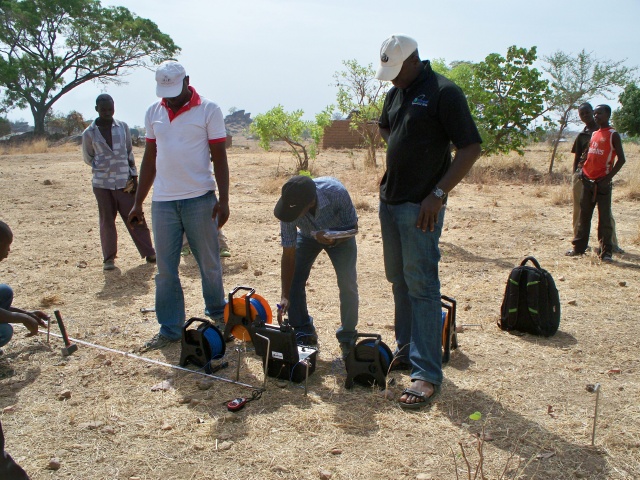
 The next morning we were to meet the geologist at 8 to leave for Waya. They were there at 7. I am impressed with them. So far everything they have done has been professional and timely. Of course they wanted to leave and we wanted to eat breakfast. We did not know when our next meal will be. While we were eating they went to get camera batteries. We finished breakfast and needed to buy a little oil for the truck. The water truck is a 1995 Toyota Hi-Lux with a rebuilt 2.8 liter diesel engine. The only size of diesel engine oil the Total Station had was 4 liters. As we added the oil, the geologist called and we told them where we were. We joined up and then got another call. The Grace and Light Mission people had arrived back at Dogan Dutse Guest House with HIV test kits for their Yola office. We told them where we were and waited for them. The test kits were quite useful at the check points. When the soldier or police man asked what was in the bag and we said HIV test kit. He would look at me and I assume he assumed I was a doctor and would wave us through. Much easier than when our clothes or computer bags were on top of the piles.


Waya is a small village that was visited by a pastor from North Dakota a number of years ago. He was disturbed at the water the people were drinking. He decided he cannot help everyone in the world but he can help this one village. He has now contributed enough money to install two boreholes, two VIP latrines and provide sanitation/hygiene training in the village. VIP latrines are Ventilated Improved Pit latrines (not Very Important People latrines). The LCCN water program is part of the overall medical efforts of the LCCN to reduce illness and preventable deaths. Clean water at the water source by itself has a little effect on health. Clean water that is kept clean by proper sanitation and hygiene efforts have a greater effect. Hand washing, proper food handling and using a VIP latrine (followed by hand washing) will have the greatest effect on the health of the village. Sanitation and hygiene are harder to sell to the villages and the churches supporting the villages. Borehole water is seen as a status symbol and the cause and effect are immediate. When you are thirsty you drink water and quench your thirst. But for sanitation and hygiene the link between disease and sanitation is more remote and less easy to understand. When you get sick today it is harder to understand that it was caused by something you eat or drank up to 3 days ago. As long as I am up on my “Soap Box”, here is Jay’s understanding of the water priority for people living in rural villages: 1. Be able to collect enough water to live. 2. Have a water source as close to where you live and farm so you do not spend all day just collecting water. 3. Have clean water.

Hand dug well that is nearly empty. The water is muddy. Other hand dug wells had more water and were clear.
The village is split by a stream that floods during the rainy season. A single borehole would only help one side of the village. I changed my travel routine last year and visited the village on my way into Nigeria. Instead of flying from Abuja to Yola, I went by land and stayed a few day in Jos. The Jos District Church is the church that has worked with Waya in the past. The two churches in Waya are part of the Jos Distirct. Due to some confusion last year about two Pastor Emmanuels in Jos I was only able to visit Waya for a short time on a Sunday afternoon. I did not get in contact with the correct Pastor Emmanuel until Friday evening. During my brief visit I performed an initial survey and later created a draft project description and initial budget. It was 10% higher than the pastor had intended to donate. He said no problem, he can find another $1000.

Yakubu and Gary Sande from Global Health Ministries visited Waya last fall after the donor’s conference in Jos. They visited three villages. Waya and the two current mission out-reach areas of the Jos District (Gadabiyu anbd Polchi). Like my trip, their visit was brief in each village and they were not able to talk with the chief about the requirements of village participation, maintenance, sanitation and hygiene. I only visited 2 villages the third was too far for an afternoon visit. They started earlier and went to all three with the furthest village last and took back roads to Bauchi from there. They arrived late into the evening and totally worn out by the long day of driving on bad dirt roads.
 
We arrived at the less populated side village where the older Church is located with the driller, three geologists and their helper. We explained to the geologist that we did not want the borehole sited at the church because the Muslim part of the village would not use it. The geologist looked over the area and decided on three potential sites. While they were starting the geo-physical survey Yakubu went to the other side to speak with the chief. The chief had heard of the project and the village would be glad to participate. Wherever the geologist decide to put the borehole he will talk with the owner of the land and make sure they understand that it is a community borehole and he as chief fully supports the project.
 
We spent the whole day at Waya while the geologist performed surveys at six site. I spent most of the time in shade. In spite of SPF 30 sun screen my arms and neck got a little burned. This sun here is SPF 60. I had brought along a red and white checkered cloth. I soaked it in water and put it over my head to cool me and to protect my neck. I was told I looked like Yassar Arafat. As I walked up to the drillers they joked they thought that Al-Qaeda was coming. The kids would come to see the Batura but would not get close to me. For many of them I was the first white man they had seen. Others had seen me last year and Gary last fall. But they still would not get close to me until it was time for a picture.

The bad news is that the hydro-geology of the area does not look good. The basement rock is pretty solid and appears that the water is in the overburden and it the top few meters of the basement where the rock was weathered many centuries ago before it was buried. The plan is to drill through the weathered rock down into the solid material to make a reservoir to pump from. We will get the cost estimate for the work next week. We had hoped to find a site capable of handling a future solar powered borehole. But the rock fractures do not go deep. Even the hand pump may run dry. This is a site that my benefit from small check dams in the streams to force more water into the earth. The pro is a higher water table and less erosion. The con is that some loss of farm land could happen.
Little girl posed for me. I took several picture before a got a good exposure and good smile.

We ended the day at Bauchi with a visit to the Bauchi Church to talk to them about their project with Redeemer Lutheran of Minneapolis. Their companion congregation has raised enough money to install one borehole. The Bauchi Church has a mission field of six villages. All have similar problems with water. They want to put in six hand dug wells instead of one borehole. Gamakesa from the LCCN Rural Development Department had spent the previous day visiting all the sites. He will give us a cost estimate for the six hand dug wells with concrete walls, concrete covers and hand pumps after Easter. In general a properly built hand dug well is about half the cost of the borehole. The money that is available for their project will not cover 6 hand dug wells. They seemed to think that this was not a problem that Redeemer will furnish the funds. Yakubu went through the same conversation about participation that we had the previous evening in Jos. Then I told them that I was familiar with Redeemer Lutheran. That they are a small church in the poor part of Minneapolis. That they had worked hard for several years to save enough money for one borehole. I explained that Redeemer are involved with many programs in their own community. They feed the poor. They provide housing. They have youth programs and many other programs to help the poor in their community. Many of their members are poor themselves. They are a very active church that stretches their financial resources to the limits to help their neighbor in Nigeria and in America. It was hard for them to raise the money they have raised so far and do not expect that they will be able to quickly raise more money. (Sorry, my friends at Redeemer if I misrepresented you.) They were impressed that their companion was such an active church helping the poor. It probably is not my place to give the people a reality check. I have to be honest. People are always asking me to drill them a borehole. I look them in the eye and say "No". After their shocked expression goes away I tell them that "I will help you build your own borehole. Nigerians are capable of making their own boreholes. They do not need me or any other American to do it for them. We can help them by they must do it themselves."

Wednesday morning we left Bauchi headed home. Stopped at the Bauchi Church to say good bye to the Dean. His wife had hot water for tea and coffee ready for us and fried Irish potatoes. The night before he had said something about Irish and I heard coffee. I missed him saying potatoes. I asked if he was going to give us Irish Coffee? He knew what Irish Coffee was and laughed and said Irish potatoes. Yakubu did not know about Irish Coffee and did not know what was so funny. Adams, the Dean and I were laughing and poor Yakubu was wondering what the joke was. I explained it is coffee with alcohol. He asked they add a little alcohol to their coffee. We laughed again and said no, not a little. The Irish add a lot. (Sorry, my Irish friends but I have stereotyped you.)

As we were getting in the truck to head to Yola, Yakubu looked at his truck registration and insurance card. They had expired. We got past Gombe and we were stopped by the Gombe Vehicle Inspection Officers. Yakubu said "this will cost me." It cost us an hour and 7,000 naira. They had a manual typewriter with them and they typed up new registrations and new insurance papers on the spot. With as many people they had pulled over the wait was to get your turn with the typist. All very professional and official. Not like the young men in Bauchi. Like Bauchi any one with local plates were not inspected. We had plates from Plateau State.

Our final stop was in Lamurde. It was partially a waste of time. The Bible College was on holiday and the principal was not available. Global Health is interested in doing a borehole for the Bible College.The road from the main highway to Lamurde can hardly be called a road. Disconnected patches of asphalt. You spend more time on the dirt shoulder than on the road bed. Probably average 20 to 30 kilometers per hour. Finally, we stopped in Numan for an Nigerian lunch / dinner (pounded rice with okra soup and a little tuff meat. Got back to Jimeta before nightfall which is 6:30 this near the equator.

Friday, April 6, 2012

Banjiram Trip -- March 30th

Tank and people waiting in line for water.

We had expected to leave for Banjiram at around 9 AM but it was closer to Noon before we left. Yakubu drove us to Numan and stopped there for a meeting of the Medical Board Staff. A church driver then drove us on to Banjiram. We arrived fairly late in the afternoon and did not have a long time there. Banjiram is town that was relocated when the Kiri Dam was built. It is the only place I have been to in Nigeria with streets laid out in rectangular blocks.

With only one Tap Stand working effectively, the lines are long.
Last year we visited here several times to try to determine how to get the borehole at the school to produce more water. It is a 300 meter deep borehole that is artesian but produces very little water except when pumped. They have gone through two solar powered pumps and one generator powered pump. Our involvement and Yakubu's on-going efforts has lead to having the solar panels tested, the bad ones removed and the total number increased from 12 to 18 and a new high temperature pump with controller installed. This was a collaboration of the town, the Guyuk Local Government, the school, LCCN Medical Board Water Team and Global Health Ministries. The new pump is producing a lot of water. But the new distribution system is not working and the tank is not filling. These are the main complaints. The distribution system sends water to three tap stands. There is one at the water tower with 10 taps (faucets) and two remote tap stands with 8 taps each. The remote tap stands do not get much water so most of the people walk to the tap stand at the tower and join the long lines.


View from the tower of the 10-tap Tap Stand
I am not sure who decided the sizes and locations of the pipes for the distribution system but they got it backwards.The largest and shortest pipes go the 10 taps at the tank and a smaller and much longer pipe run goes to the 16 remote taps that are at a higher elevation. Almost all of the water goes to the tap stand at the tank. The fix is relatively ease but will not be the optimum design because we are stuck with the pipes already buried in the ground. We are proposing to by-pass the tank and pump the water into the distribution system directly. Also we will add to flow control valves to the tap stand at the tank and to the lower of the two remote tap stands. We will let the tap stand at the highest elevation to determine the system pressure. Adjust the two new control valves until we get approximately the same flow from each tap.

When I proposed this the people said "but you have to fill the tank". To this I said "Why? The tank does not need water the people need the water." They argued that the tank provides the pressure for the system and I argued the tank takes pressure away from the system. That if we directly pressurize the distribution system we will give more pressure to the system and may actually fill the tank from the bottom more than it is currently be filled from the top. So far engineering is winning the arguments over "we have always filled the tank first". In many places they turn off the tap stands to let the tank fill and give less water to the people. The priority for me is to give water to the people not fill the tank. My fix may actually fill more water into the tank than the current system. This is a hard concept to understand.

Collection water at leaking joint.
One other costly fix is to replace all of the taps (faucets) with automatic closing valves (spring loaded). The current taps are turned on wide open all the time. Whether there is a bucket under it or not. Some water is wasted. I am sure that this will create complaints. We have a few other minor fixes (sealants on joints to reduce leaks, etc) and so improvements in sanitation but the main fix is the by-pass pipe, the control valves and the spring loaded taps.

Monday, March 26, 2012

Pictures From This Week March 19 to 26

This week has been a week of setting up the house and a lot of walking. I have walked to the Market most days.

The Harmattan dust has gotten light enough for me to use the sun. My 2011 solar cooker was still in the house. I brewed a liter and a half of tea while I fixed, washed and sun dried some cylinders for the India Mark II hand pumps.

Reconstruction continues at the Cathedral. They are about finished with the new ceiling tiles, then the electrical. The main setback is the new windows. They want to be able to have Easter service in the Cathedral. They can finish most things but the windows. We will see in less than two weeks.

The brass and percussion sections of the Boys & Girls Brigade Band continues to practice at the side and  back of my house. I tried to upload a video of the percussion section but is does not appear.

One morning on the way to shop I saw a bunch of kids playing in the pews. I gathered them up at the back pews for a picture. As I was about to take the picture the tall boy sees us, comes running up to get in the picture and yelled "Wait Grandpa". What I wish I could do is get a video of the kids looking at the picture in the camera.

 Sunday the Cathedral Bells started ringing at 6AM. The Boys Brigade post guards at the entrances and on the roof of the toilets from my point of view he is standing on the canopies. The Youth Band started singing greeting songs a little before 8 AM. The crowd moved in for the next hour. The service started around 8:15. This is a combined English & Hausa service. There will be little English. Also today representatives of the Christian Pilgrims Commission have come to talk about the Federal Government decision to stop paying for pilgrims. Last year over 20,000 Nigerian Christian Pilgrims went to the Holy Lands. They fill chartered planes for the trip. One person told me they thought the costs was something like $500 per person. Archbishop Babba who is a member of the Commission made the announcement. Being a pastor he took about 1/2 hour and being the funny person he is he had the crowd laughing. He encouraged the church to collect their own money and send some of the leaders or elders or pastors to the Holy Lands each year. My thoughts were to not support the people with the ability to support themselves but to send regular members and youth. The youth are the future of the church.

After the Commission the Yola Diocese Bishop installed the new District Pastor for the Jimeta District. Rev. Raymond Edwards. He is not the pastor at the Cathedral. The choir had a special song for the day and the Women's Fellowship had a song. The sermon started around 9:30 and Communion started around 10:15. Of the around 3500 people there many had left after the offering and maybe 2000 thousand were left for communion. The Pastor told them to be orderly and that not everyone can be first. So a majority jumped up into the aisles to get in line. They had several extra pastors present so they had three lines. I went back to the house for water and discovered that the power was on. I quickly plugged in all my electronics for recharging. Then went back to get in line. The service ended a little after 11 and so did the power.

On Saturday Yakubu, Teresa, the trainers from Kenya and I went to the market. I showed Yakubu the propane burner I wanted. He went to a vendor and got him down to 3500 naira. As of Saturday I had an empty propane burner. Monday Adams and I were to go to the Yola Diocese Bishop's new quarters to measure the depth of the water and depth of the borehole. Adams had to go to a government meeting on his pension. The government is trying to clear the roles of the deceased pensioners. The Diocese sent a bus (van) to pick me up. I got stuck in the sand  by the house. They gathered guards and everyone else and pushed it out.

Unfortunately, the diocese had not asked Yakubu and Adams to be involved with choosing the driller or making sure the borehole was properly drill. It was drilled on a slant and I had a hard time getting a weighted tape measure down to the water. We have no idea the depth of the borehole. Today (Tuesday) we are suppose to pump test the borehole. I think we may not be able to accomplish this until we find out how deep it is. On our way back, we stopped and a cooking gas peddlers shop and filled the tank. He saw me and said 2000 Naira. I told him we will go to the market and fill it for 1500. He took the tank and filled it. Then he asked for 200 more. I gave him 100 more and he was happy.

Cooked chicken noodles on the new stove. Last night and this morning I will have my first hot oat meal breakfast.

Power lasted this morning from 4:15 to 7:05 enough time to reduce the pictures, upload them and write this post. I am going to publish it unedited. I edited it Tuesday night. There were not too many typos I found.


Thursday, March 22, 2012

March 22nd - LCCN Deaf Centre – Two people named Abdullahi


Earlier this week on my way to the market I stopped at the LCCN Deaf Centre to see if Ruth Ulea was there. The teacher who signed back that she was working off-site. I took this picture of the students, the teacher and a mother of one of the students.
Today Ruth and the teacher came over and I struggled to communicate with them. I only have two classes in ASL (over a year and a half ago) and the Nigeria ASL has been separate from the US ASL for many years. Like all languages this separation had created differences. Similar to the differences between Maine's version of English and Cajun English  in rural Louisiana. This is a natural progression of language. When I was stationed with the Brits in Bosnia we had the same problem. The General I worked for would say “two peoples separated by a common language.” It helps that Ruth speaks and can lip read English and Hausa. She lost her hearing as a teen.

After they left I realized I had forgotten the teacher’s name. I had met him last year when he was home from Jos University where he was studying Special Education. I went over to the Centre and asked him to write down his name. Ishaya Yakubu. Class was over for the day and there where three kids left to have their parents come get them. Ishaya told the youngest child to sign something to me. I did not know and figured he was signing his name. My comprehension of finger spelling is slower than this little guy was going. I need more practice. He kept going and going. I got lost after about 15 letters and the last letter was Z. He had done the alphabet. He is the center kid in the picture in the row closest to the camera. He has the odd smile trying to imitate me as I tried to get the kids to smile for the picture. Say Cheese does not work. He looks lighter than the other kids for two reasons. He was closer to the door but also he is Fulani. Fulani are more light skinned. His name is Abdullahi Adamu.

Abdullahi was born deaf and living with the Fulani who are nomadic herders.